Food for the Soul Pilgrimage Guide to Hachioji and Mount Takao, Tokyo, Japan
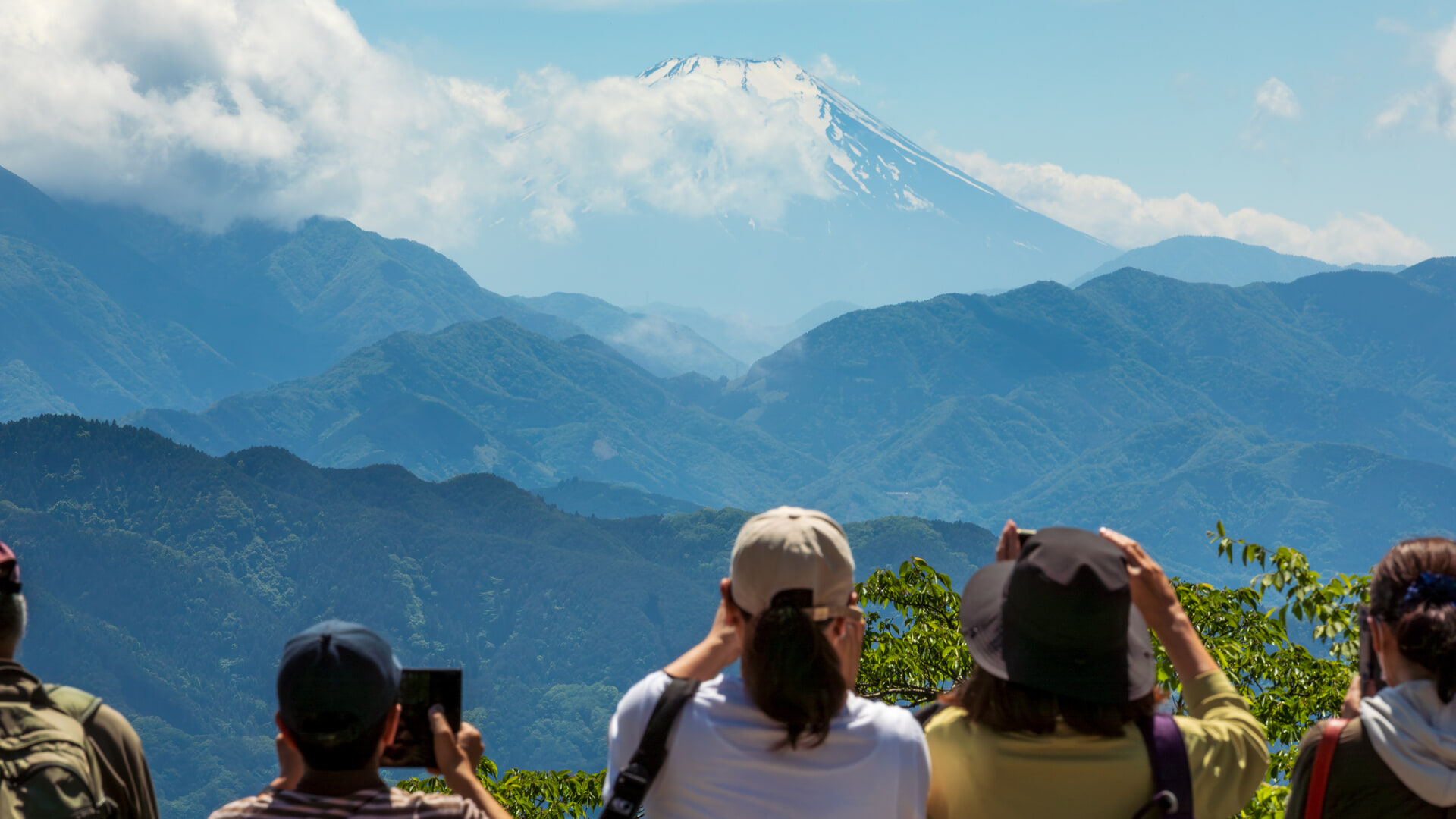
Header photo: walkers at the summit of Mount Takao looking at Mount Fuji. Photographed in May 2024. Photo: Ximonic (Simo Räsänen), CC BY-SA 4.0 (cropped and resized). Source.
Food for the Soul — 日々は過ぎれど飯うまし, a cooking and everyday-life series rather than a travelogue — is set in Hachioji, the large western city of Tokyo, and it climbs Mount Takao in episode 3. That combination is unusually good for a day out. Takao is forty-odd minutes from Shinjuku, has a cable car, a mountaintop temple, teahouses on the path and a view of Mount Fuji on a clear day; Hachioji below it is a working city with a Japan Heritage designation, a Chinese restaurant on the official pilgrimage map, and a roadside station that sells the vegetables the series keeps cooking with. The mountain and the city are two different days, and the one to decide first is the mountain: the cable car and the chair lift both stop halfway up, not at the summit, and they stop running at different times. The Japan Heritage project behind the map is described in Japanese.
Quick Trip Guide
- Series: Food for the Soul (日々は過ぎれど飯うまし), original TV anime from April 2025, P.A.WORKS
- Where: Hachioji, western Tokyo, and Mount Takao
- Getting there: Keio Line from Shinjuku to Takaosanguchi, about 50 minutes on a semi-special express
- On the official map, and visitable: Takaosanguchi Station, the lift base, Gongen-jaya, Yakuo-in, Yamabiko-jaya, the summit, Michi-no-Eki Hachioji Takiyama, Daishintei, the Old Koshu Kaido. Goryo Shrine is named on the map too, but is not routed here — see the spots section
- Up the mountain: Cable car or chair lift to the halfway stations, not the summit — 490 yen one way, 980 return for adults — then Trail 1 on foot; or walk the whole way. The operator’s timetable gives the cable car’s last departure by month (17:45 on weekdays and 18:00 at weekends in September, October and November) and the lift’s last ride at 16:30 from May to November, 16:00 from December to April
- Time needed: One day for Takao. Hachioji city is a separate half-day
- Best season: Autumn for the colour, winter for the clearest Fuji, any time for the food
- Eating: Pace it. The approach is a street of small shops, not a buffet
- Budget: Low to moderate. The mountain is free if you walk it
Why Hachioji Matters in Food for the Soul
Food for the Soul is about five university students, a club that was invented to get hold of a room, and what they eat. Mako Kawai cooks for herself every day and cannot bring herself to walk into a restaurant alone. In the first episode a classmate’s mother puts a sauce katsudon in front of her, and the series is off: a food culture research society with no equipment, a shy girl learning to sit down at a table, and a lot of very specific meals.
A club that started as a lie
The official character pages are unusually useful here. Mako Kawai loves eating, is good at cooking, and is shy enough that speaking to people is hard work. Shinon Ogawa is the club president, Mako’s childhood friend from primary school, cheerful and prone to acting without a plan — and, as episode 2 makes clear, the food culture research society was a dummy club she invented to get hold of a room. Kurea Furudate is the one who holds it together and who helps at her family’s restaurant. Tsutsuji Higa watches everybody and panics when something goes wrong. Nana Hoshi joins later, after failing to start a puzzle club, and is so shy it is a plot point.
The sixth name on the character list is Mokotaro, who is not a student but the mascot of a food video channel the characters watch. He is why they go where they go, which is a very 2020s way to end up on a mountain.
Why that makes this a good trip
Because the series is about being able to go and eat something. The first episode is Mako failing to walk into a restaurant on her own and then, with somebody beside her, eating a sauce katsudon. Episode 3 is the whole club going up Mount Takao, browsing the souvenir shops on the approach, eating as they walk, and stopping at a teahouse near the summit that one of them recognises from a video.
That is a real day out that you can have, in the order they have it, and it is one of the best cheap days available from central Tokyo. The mountain is forty-odd minutes from Shinjuku, the path is lined with places selling things on sticks, and there is a temple most of the way up.
Which Food for the Soul
An original anime, not an adaptation. The character and story concept and the manga storyboards are by Atto, the original work is credited to team apa, and the animation is by P.A.WORKS; it began in April 2025. There is a manga, but it is a comicalisation made from the anime rather than the source. Atto also created Non Non Biyori, which is a reason to expect this series’ particular patience with ordinary afternoons — but the two works are not set in the same place, and nothing here should be read as a Non Non Biyori location.
Where the spot names come from
- The spot names below are the ones shown on the official pilgrimage map produced for the Japan Heritage town of Hachioji. Pick the map up — it is free, it is numbered, and it has more on it than is listed here. It has been handed out since 4 March 2026 at the Hachioji and Takaosanguchi tourist information centres, the Hachioji Convention and Visitors Bureau, Keio Takaosanguchi, Takao and Minami-Osawa stations, the cable car’s Kiyotaki Station, Michi-no-Eki Hachioji Takiyama, the Minami-Osawa outlet and the city hall.
- Handing out the map does not make a place a location. The tourist offices, the city hall, the Keio stations and the Minami-Osawa outlet mall are distribution points. Where this guide says a place is on the map, it means a photographed, captioned entry on the map itself.
- The life-size panels toured Michi-no-Eki Hachioji Takiyama (4 to 30 March 2026), the Minami-Osawa outlet (8 March 2026) and Keio Takao Station (1 to 19 April 2026). After 20 April 2026 they were to move “in turn” to other facilities, with no schedule published. Do not travel expecting to find one.
- Episodes 5, 7 and 10 go to Tsukiji, a training camp and Mako’s grandmother’s house. They are not in Hachioji and are not folded into the Hachioji walks here.
Anime Pilgrimage Spots
Grouped the way the trip works: the mountain, which is one continuous walk, and then the wider city, which is not.
Please respect local rules and manners at every location, and follow signs and staff guidance.
Where these places are
The map shows the places below and how far apart they are. It is drawn with OpenStreetMap: opening it loads map images from openstreetmap.org. The list works without it.
The map could not be loaded. The places are listed below, with their names and a link to each on Google Maps.
- Anime-related places
- Station or transport
- Nearby sight
The 7 places on this map
- 1Takaosanguchi Station高尾山口駅Mount TakaoIn this guideOpen in Google Maps
- 2TAKAO 599 MUSEUMTAKAO 599 MUSEUMMount TakaoIn this guideOpen in Google Maps
- 3Kiyotaki cable car station清滝駅Mount TakaoIn this guideOpen in Google Maps
- 4Takaosan Yakuoin高尾山薬王院Mount TakaoIn this guideOpen in Google Maps
- 5Mount Takao summit高尾山Mount Takao · area positionIn this guideOpen in Google Maps
- 6Hachioji Station八王子駅Hachioji cityIn this guideOpen in Google Maps
- 7Minami-Osawa Station南大沢駅Hachioji cityIn this guideOpen in Google Maps
Map data © OpenStreetMap contributors, ODbL. Positions were checked on 15 October 2026 against the source recorded for each place; a few are the published position for a large site rather than an entrance.
Mount Takao: the Trail 1 walk
The official map devotes an enlarged inset to Trail 1, the paved main route, and the entries on it run in the order you would actually meet them. Episode 3 follows that same shape: the approach, the shops, the climb, a teahouse, the top.
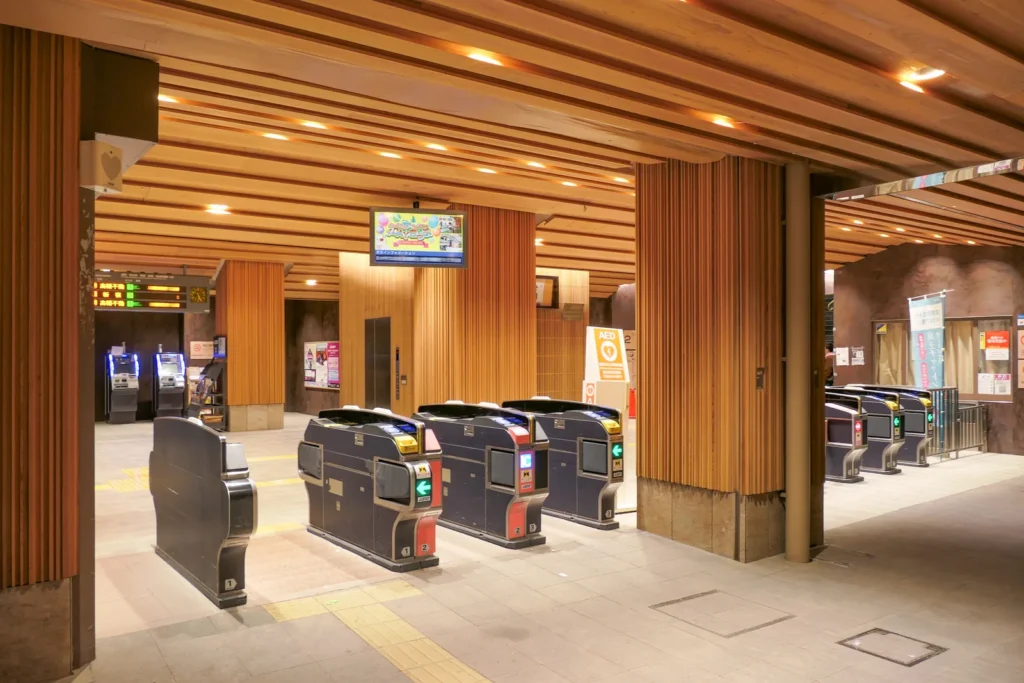
Takaosanguchi Station
The first entry on the map inset and the start of everything: the Keio Line terminus, rebuilt in cedar by Kengo Kuma, with a long slatted roof and a wall of timber that makes a surprisingly good first photograph. Inside there is tourist information, which is one of the map pick-up points, and lockers — use them, because carrying a day bag up Trail 1 is the most common unforced error here. The hot spring complex is next door, which is the right way to end the day rather than the right way to start it. Keio Line from Shinjuku, direct on some services, otherwise one change at Kitano or Takao.
The cable car and the chair lift
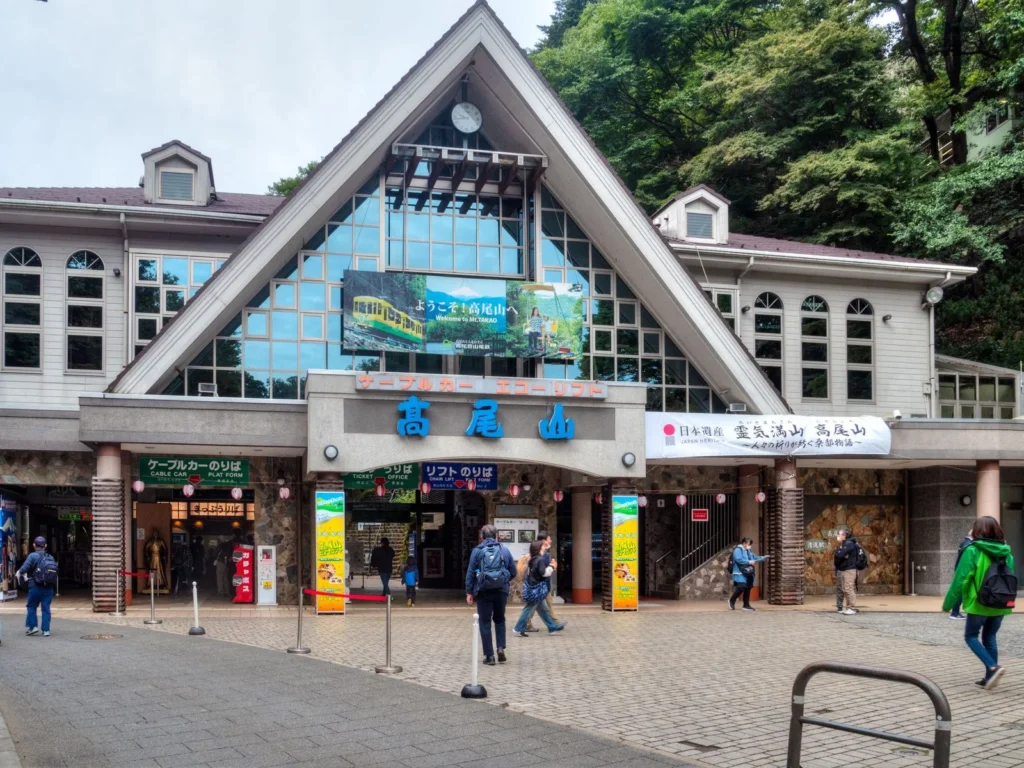
The map marks the chair-lift base station, which is the open two-seat lift rather than the cable car. Both start a few minutes’ walk up from the station, both end roughly halfway up the mountain, and both cost 490 yen one way and 980 yen return for adults, 250 and 500 for children aged 6 to 11, with under-6s free.
- The cable car takes about 6 minutes, runs every 15 minutes and starts at 8:00. It is enclosed and climbs a famously steep gradient.
- The lift takes about 12 minutes in the open air, which is lovely in autumn and miserable in rain. It runs 9:00 to 16:30 on weekdays from May to November, and to 16:00 from December to April.
- Or walk: Trail 1 is paved the whole way. The Takao Visitor Center gives it as 3.8 km with a standard time of 1 hour 40 minutes up and 1 hour 20 minutes down, from the foot of the mountain to the summit. Up on foot and down by cable car is a good compromise, and so is the reverse.
Plan the day backwards from the last cable car down. Its departure changes with the month and with weekdays versus weekends, and the operator publishes it as a table rather than as one figure, so check it on the day. This is the single thing most likely to go wrong on a Takao afternoon. Keep the two published walking times apart: the railway’s forty minutes is the upper leg only, from Takaosan Station to the summit, while the 1 hour 40 up and 1 hour 20 down are for the whole of Trail 1 from the bottom. If the cable car has stopped, the way down is the second figure, not half the first.
Gongen-jaya, Yakuo-in and Yamabiko-jaya
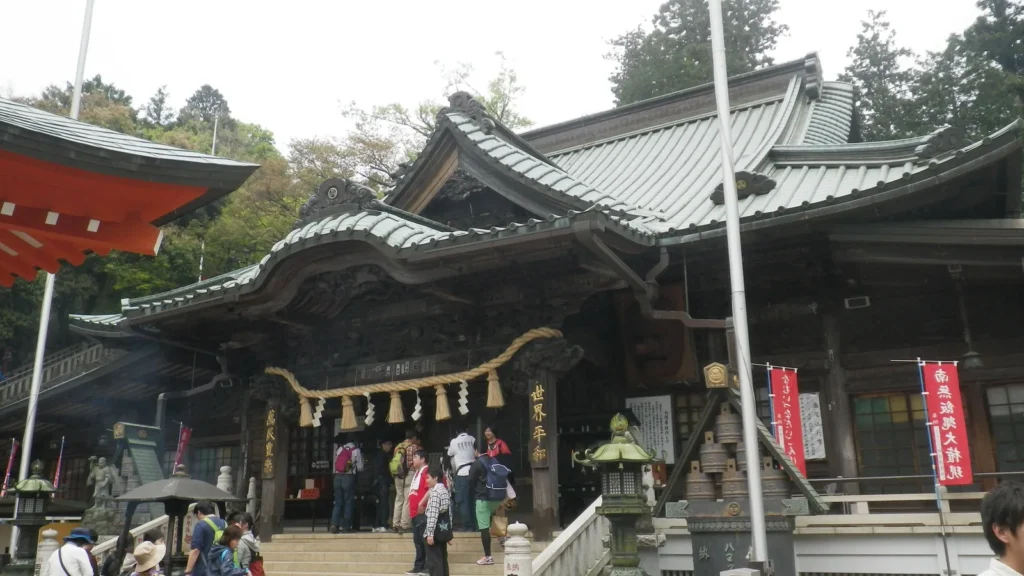
Three map entries in a row along the upper path. Gongen-jaya is a teahouse on the approach above the cable car station. Takaosan Yakuo-in is the mountain temple: a Shugendo site associated with tengu, with fire rituals, a gate guarded by statues, and a temple office open 9:00 to 16:00. Yamabiko-jaya is the teahouse near the top — the kind of place episode 3’s group sit down at after recognising it from a video.
The summit
The last entry on the inset. On a clear winter day Mount Fuji sits on the horizon beyond ridge after ridge of hills, and the viewing platform has a crowd of people photographing it, which is what the picture at the top of this guide shows. There are benches, a visitor centre, and more teahouses.
A Takao day that closes properly
That order works as a real plan. The shape that leaves least to chance: bags in a locker at the station, up Trail 1 on foot for about 90 minutes with a stop at Gongen-jaya, Yakuo-in on the way through — the temple office is open 9:00 to 16:00 — then the summit for the view and the benches, back down to Yamabiko-jaya for the sit-down the episode is really about, and the cable car down with time in hand.
Two bookings decide the food. Yakuo-in’s shojin ryori is served by prior arrangement rather than by walking in, so if the temple meal is the point of your day, arrange it before you travel. The teahouses on the path keep their own hours and close earlier than you would expect on a mountain that is busy until dusk, so eat on the way rather than planning a late lunch at the top. If you would rather eat at the bottom, the approach street below the station is where to do it, and the hot spring next to the station is open afterwards.
The wider city
These are the map entries that are not on the mountain. Hachioji is a large city and they sit in different parts of it, so each one is a short train or bus ride from the next rather than a continuation of the same walk.
- Michi-no-Eki Hachioji Takiyama: The roadside station in the north of the city, on the map and also a distribution point for it. Local vegetables, a food court and a farm shop — which lines up neatly with episode 9, where the club goes to a roadside station for ingredients and comes back with venison for a soup curry. It is well away from the stations; check the bus or drive.
- Daishintei: A neighbourhood Chinese restaurant, photographed on the map with its own sign. Episode 12 opens with Mako going to a machi-chuka after seeing it in a Mokotaro video and ordering a very large hui guo rou set. It is a small working restaurant: go at a normal mealtime, order properly, and do not photograph the interior without asking.
- Goryo Shrine: A shrine photographed on the map, hung with lanterns. We could not establish from an official source which shrine of that name it is or where in the city it stands, so it is named here and left out of the routes below rather than sent you after on a guess.
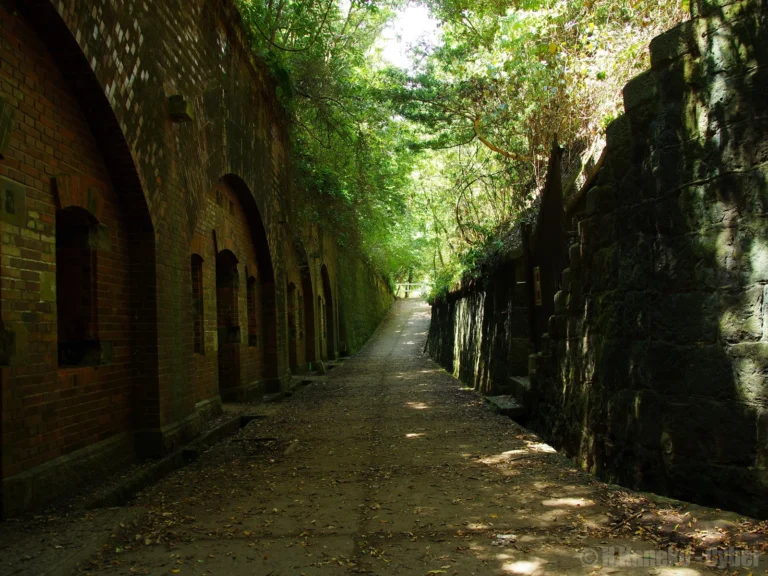
- The Old Koshu Kaido: The old highway, photographed on the map as a walled lane. Hachioji was the largest post town on the Koshu road, and this is what is left of it — a stretch to walk rather than a building to visit.
Two things this guide does not claim
- The Minami-Osawa outlet mall hands out the map. Episode 6 does go to an outlet. No official source says they are the same outlet, so this guide does not say so either.
- The map carries more entries than are named here, including stops in the city centre. The paper map is the complete list.
- No opening hours or menus are given for Daishintei or the two teahouses, because none could be confirmed from the businesses themselves.
- The university, the club room and the characters’ homes are not identified, here or anywhere official.
How to Get There
To Mount Takao
- Keio Line from Shinjuku to Takaosanguchi is the way almost everybody goes: around 50 minutes on a semi-special express, sometimes direct and sometimes with one change at Kitano or Takao. The Keio fare is low, and Keio sells a Takaosan Ticket that bundles the return journey with a discounted cable car or lift ride.
- JR to Takao, on the Chuo Line, then one stop on the Keio Line to Takaosanguchi. Useful if you have a JR pass, but the pass does not cover that last stop.
To Hachioji city
- JR Hachioji — the Chuo Line station, and the main one.
- Keio-Hachioji — a different company and a different station, a few minutes’ walk away.
- Nishi-Hachioji and Takao — further west on the JR Chuo Line. The order out of Hachioji is Hachioji, then Nishi-Hachioji, then Takao, so Takao is two stops. Minami-Osawa is not on this line at all: it is on the Keio Sagamihara Line, which leaves the Keio Line at Chofu, so from Shinjuku you take a Keio Line train and change at Chofu, or ride a service that runs through. It is a map pick-up point rather than somewhere this guide sends you.
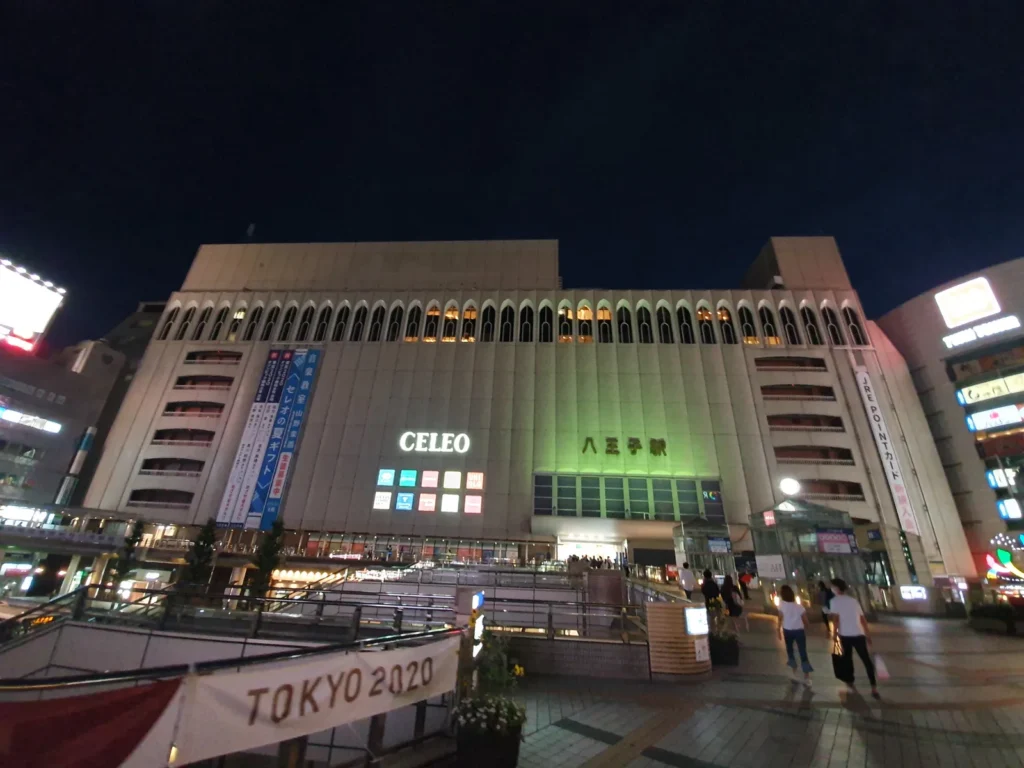
Do not treat Hachioji as one walkable place
- JR Hachioji to Takaosanguchi is a train journey: JR to Takao, then one stop on the Keio Line, or Keio all the way from Keio-Hachioji.
- Minami-Osawa is on the Keio Sagamihara Line, which branches off at Chofu — not reachable by changing at Keio-Hachioji.
- Michi-no-Eki Hachioji Takiyama is in the north of the city with no station of its own. Its own access page gives buses bound for Tobuki via the Hiyodoriyama tunnel, from Keio-Hachioji Station stop 4 or JR Hachioji Station stop 12, getting off at Michi-no-Eki Hachioji Takiyama Iriguchi for a three-minute walk. Or drive. Check the frequency for your day.
- Plan Hachioji city and Mount Takao as different days or different halves of a day, with a train in between.
Best Way to Get Around
On the mountain
Trail 1 is paved from the station to the summit, and it is the route the official map insets. Two official figures cover it, and they are not the same walk. The railway gives about 40 minutes on foot from its own Takaosan Station, the cable car’s top station, up to the summit — the upper leg only. The Takao Visitor Center gives the whole trail, from the foot of the mountain to the summit, as 3.8 km with a standard time of 1 hour 40 minutes up and 1 hour 20 minutes down. Those are standard times for a steady walker, so add your own stops to them.
- Walk up, ride down if you want the exercise without the descent on your knees. Remember that the top station is not the summit: the cable car operator gives the summit as about 40 minutes on foot from Takaosan Station going up, and publishes no time for coming back down. For the full descent the Visitor Center does: 1 hour 20 minutes on Trail 1 from the summit to the bottom. Leave the summit with the short walk to the station, the last departure, and that 1 hour 20 all in hand, and be ready to walk the whole way down if the service has stopped for weather.
- Ride up, walk down if you want the summit early and the shops on the way back.
- Ride both ways if you are short of time, but then the day is about two hours of mountain and you should build the rest of it in advance.
Trails 6 and the Inariyama route are unpaved alternatives for the descent and need proper walking shoes or boots. Trail 1 is paved, but it is still a mountain path: it is steep in places and slippery in the wet, so wear something you can walk and grip in, not sandals or smooth-soled shoes.
In the city
Trains between the Hachioji stations, and buses from JR Hachioji or Nishi-Hachioji for the roadside station and the outlying spots. Check the route and the frequency for your day. A car makes Michi-no-Eki Hachioji Takiyama and the Old Koshu Kaido much easier and makes Takao harder, because the car parks near Takaosanguchi fill early in autumn.
What to Eat
The series is about food, so this section is doing real work. The important rule: do not try to eat everything in one day. The approach to Takao is a street of small shops selling rich things, and the mountain is a climb. Two or three stops is a good day; six is a bad afternoon.
On the mountain
- Tengu-yaki — a black-bean-filled cake pressed in the shape of a tengu’s face, sold near the cable car station. The most Takao thing there is.
- Dango and manju on the approach, including the sesame varieties the mountain is known for.
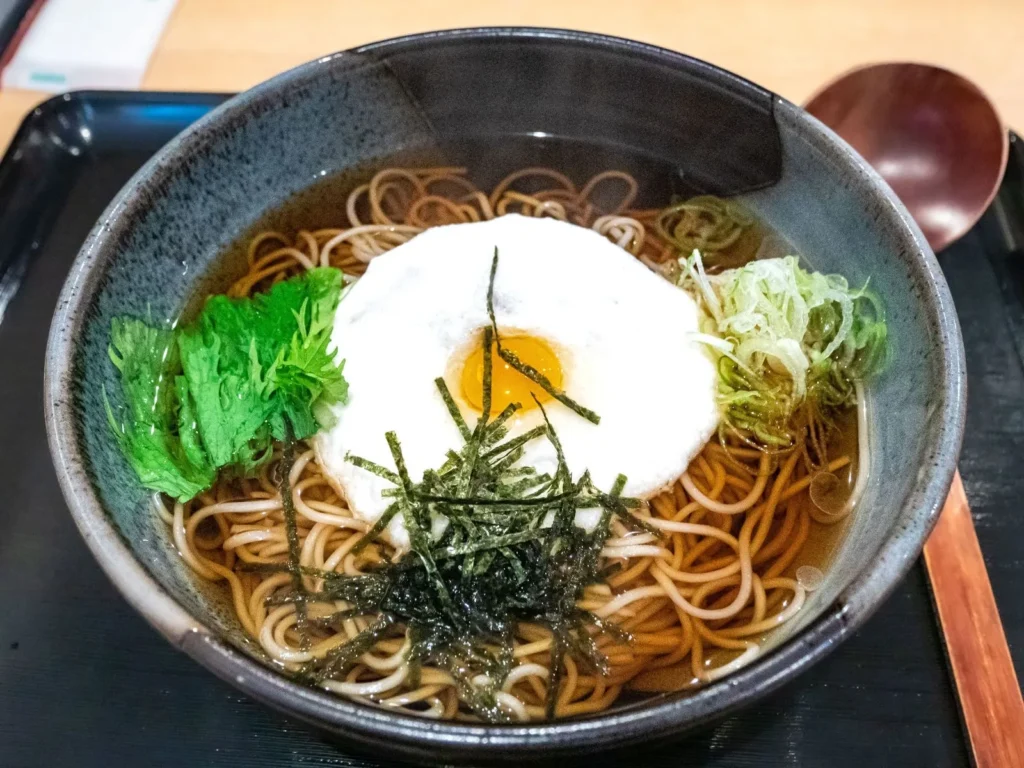
- Soba — the serious meal on Takao, served in the teahouses and restaurants along Trail 1 and at the foot of the mountain. Tororo soba, with grated yam, is the local standard.
- Shojin ryori at Yakuo-in — vegetarian temple cuisine, by advance arrangement rather than by turning up.
In the city
- Hachioji ramen — the city’s own style, soy-based with chopped raw onion on top. Easy to find around the stations.
- Machi-chuka — the neighbourhood Chinese restaurants the series goes to in episode 12, of which Daishintei is the one on the official map.
- Sauce katsudon — the dish Mako eats in episode 1: a breaded pork cutlet dipped in sauce over rice, no egg. Common enough in the area to find without a pilgrimage.
- What the roadside station sells — Michi-no-Eki Hachioji Takiyama is a working farm shop, and episode 9 is about exactly that: going to one and cooking with what you find.
Beyond the Anime: More to See
None of these is a location from the series. They are here because Hachioji is a Japan Heritage town and because Takao is worth more than one visit.
The Soto Monogatari, and why Takao has a temple on it
Hachioji’s Japan Heritage story is called Soto Monogatari, the tale of the mulberry capital. The city grew rich on silk — sericulture and weaving — and became the largest post town on the Koshu road. The warlord Hojo Ujiteru built the castle town in the late sixteenth century and prayed at Mount Takao, and the silk farmers and merchants who came after him protected the mountain as a sacred place. That is why there is a Shugendo temple most of the way up a mountain forty minutes from Shinjuku, and it is a much better frame for the walk than “famous day hike”.
Around the mountain
- Takao 599 Museum — free, at the foot of the mountain near Takaosanguchi, and a good half-hour on what lives on Takao.
- Keio Takaosan Onsen Gokurakuyu — the hot spring beside the station, which is the correct way to end a day of walking down a mountain.
- Mount Jinba and the ridge — the long walk west along the tops, for people who find Takao too easy.
In the city
- Hachioji Castle ruins — a national historic site in the hills west of the centre, with excavated garden remains.
- Takiyama Castle ruins — earthworks in the north of the city, near the roadside station.
- The Hachioji Festival — the city’s big summer festival, with floats and the Hachioji geigi.
- Weaving and dyeing workshops — the Japan Heritage programme runs craft courses in the city; book through the official portal rather than turning up.
Souvenirs and Where to Buy Them
- Tengu-yaki and sesame sweets from the approach shops — the mountain’s own souvenir, best eaten the same day.
- Takao tengu goods — charms and small carvings from Yakuo-in and the shops on the path.
- Hachioji silk and multi-fabric weaving — the Japan Heritage craft, available in the city rather than on the mountain.
- Farm produce from Michi-no-Eki Hachioji Takiyama, which is the most in-character souvenir in this guide.
- The pilgrimage map itself — free since 4 March 2026 at the three tourist information centres, the Keio stations at Takaosanguchi, Takao and Minami-Osawa, the cable car’s Kiyotaki Station, the roadside station, the Minami-Osawa outlet and the city hall. Stock is not guaranteed after this long; ask.
There is no permanent official shop for the series that we could find, and the 2026 panel tour has moved on from its published venues. If a campaign is running when you travel it will be on the Japan Heritage portal.
Where to Stay
Honestly: most people do this from Tokyo and go home the same evening, and itinerary A is written that way.
- Stay in Tokyo — Shinjuku is 50 minutes from Takaosanguchi. This is the default and it is the right answer for one day.
- Stay around JR Hachioji — business hotels, and the right choice if you want the city half of the trip without rushing, or an early start on the mountain in autumn.
- Stay at Takaosanguchi — a small number of places at the foot of the mountain, for a dawn start or a long soak after the walk.
Autumn weekends on Takao are extremely busy and the mountain is one of the most visited in the world. If you are coming in November, start early rather than booking clever.
Suggested Itinerary
This is a series about eating well with friends, so the useful plan here is a meal plan with a walk attached. Mount Takao is one continuous route and the rest of Hachioji is not: the city entries sit in different districts, each a train or bus ride from the next.
| Which trip | Mount Takao | Hachioji city | Minami-Osawa |
|---|---|---|---|
| What | Trail 1, the teahouses, Yakuo-in, the summit | The roadside station, a neighbourhood Chinese restaurant, a local shrine | A separate district on the Keio Sagamihara Line |
| Time | Half a day minimum, a full one if you walk both ways | Half a day, spread out | An hour or two, best bolted on to a city day |
| Eating | Teahouses on the path; shojin ryori at Yakuo-in by prior arrangement only | The point of the city half — go at normal mealtimes | Shopping-centre food |
| Plan around | The last cable car down, which changes by month | Restaurant hours and days | Nothing much |
A is the trip: one day, no car, and it follows episode 3 in the order the episode has it. B adds the city. C is for the parts of the series that are not in Hachioji at all.
A — One day on Mount Takao
- 09:00. Keio to Takaosanguchi. Collect the pilgrimage map at the tourist information centre and leave anything heavy in a locker.
- 09:30. The approach: souvenir shops, tengu-yaki, and the start of the climb. This is the part of episode 3 that is just browsing and eating — give it half an hour rather than five minutes.
- 10:00. Up. Either Trail 1 on foot — 1 hour 40 minutes to the top on the Visitor Center’s standard time, so nearer 12:00 than 11:30 once you stop — or the cable car or lift (490 yen one way) to the halfway point and then about 45 minutes of walking.
- 11:00. Gongen-jaya, then Yakuo-in. The temple deserves half an hour; the office is open 9:00 to 16:00.
- 12:30. Yamabiko-jaya near the top, and lunch. Soba, or something on a stick, or both if you walked up.
- 13:30. The summit. In winter this is where Fuji is, and the viewing platform is worth waiting at for a gap in the crowd.
- 15:00. Down. On foot, Trail 1 is 1 hour 20 minutes to the bottom on the Visitor Center’s standard time, which puts you at the station at about 16:20 with the hot spring still ahead of you. If you are riding, check the cable car’s last departure for your date before you start descending — it changes month by month and between weekdays and weekends.
- 16:30. The hot spring beside Takaosanguchi Station, then the train back.
What has to be true: you are off the summit with enough margin for the last car, or you are walking down. In December and January the light goes early and the lift stops at 16:00.
B — Adding the city
A second day, or the morning of a longer one. Michi-no-Eki Hachioji Takiyama in the north for the farm shop and the food court, the Old Koshu Kaido for the old highway through Hachioji, and Daishintei for the episode 12 meal. These are spread across a large city and need trains, buses or a car between them — pick two, not three, and look up how you are getting between them before you set off. Goryo Shrine is on the map but not on this route.
C — The parts that are not in Hachioji
The series travels. Episode 5 goes to Tsukiji for seafood and then to a barbecue by the sea; episode 7 is a training camp reached by a retro train; episode 10 is at Mako’s grandmother’s old house with a wood-fired stove. None of these is in Hachioji, none is on the official map, and this guide does not place them. If you want the Tsukiji morning, do it as a separate Tokyo half-day and do not try to bolt it onto a mountain.
Travel Tips and Etiquette
It is a mountain and a temple, in that order
- Shoes. Trail 1 is paved but steep. Trails 6 and Inariyama are not paved at all.
- The last car. The single most common way to spoil a Takao day. Look it up on the day.
- Yakuo-in is a working temple. Fire rituals happen on a schedule; do not walk through one, and do not photograph people at prayer.
- Autumn. November weekends bring queues for the cable car measured in hours. Go on a weekday, or go early, or walk.
- Weather. Fuji is a winter thing. In summer haze you will not see it, and that is normal rather than bad luck.
In the shops
The approach shops and the teahouses are small family businesses on a mountain. Queue, order, eat where they ask you to eat, and take your rubbish with you — bins are scarce on Takao by design. Ask before photographing inside anywhere, and accept no.
Places not to go looking for
The university, the club room, the dormitory and the characters’ homes are not identified by the project and are not identified here. Do not go to campuses or residential buildings looking for them. The official map is the list.
Practical
- Five stations. JR Hachioji, Keio-Hachioji, Nishi-Hachioji, Takao and Takaosanguchi are different places. Minami-Osawa is further still.
- Two railways. Keio and JR are separate; a JR pass does not cover the Keio stop at Takaosanguchi.
- Cash. Small shops and teahouses on the mountain may not take cards.
- Water. Carry some. The summit sells it, but at summit prices.
Plan Your Trip
The guides below are suggested as route pairings rather than shared ground:
- Bocchi the Rock! in Shimokitazawa — the other end of the same Keio and Odakyu corridor, and another series about a shy girl and a club.
- anohana in Chichibu and Botan Kamiina in Chichibu and Nagatoro — the mountains on the other side of Tokyo, and the same kind of day with a different flavour.
- Slam Dunk in Kamakura and Enoshima and Girls und Panzer in Oarai — for the coast instead of the hills.
- Yuru Camp in Yamanashi and Shizuoka — keep going west from Takao and you are in it.
How this guide was put together
This guide was researched and planned from published sources rather than written up from a visit. Checked on 12 October 2026: the official location map for which entries exist and in what order along Trail 1; the Takaotozan Railway for the cable car and chair lift fares, running times and seasonal hours; and Takaosan Yakuo-in for the temple office hours and for the fact that its shojin ryori is by arrangement.
Where the walking times come from. The Takao Visitor Center publishes standard times for each trail; for Trail 1 it gives 3.8 km, 1 hour 40 minutes up and 1 hour 20 minutes down, from the foot of the mountain to the summit, read on 25 October 2026. The railway’s forty minutes is a different and shorter walk — Takaosan Station to the summit — and it publishes nothing for the way back down. No single last-cable-car time is printed here, because the operator publishes a table that varies by month and day. Being a map distribution point does not make a place a location in the series, and the guide says which is which. Individual teahouse hours are not published in one official place: the operator’s shop directory was under maintenance when this was checked on 25 October 2026, and the hours that circulate on third-party listing sites are not the shops’ own. Ring ahead if a particular teahouse is the point of your day, and in any case eat on the way up rather than planning a late meal at the top.
Written and edited by Nick, who runs Anime Routes Japan from Japan. More about Nick, and about how these guides are made, is on the About page.
The practical details here — opening hours, fares, access and the operators’ own requests — were checked against official sources on 12 October 2026: the work’s own site and its episode synopses, the Japan Heritage portal for the pilgrimage map and the panel tour, the Hachioji Film Commission, the mountain railway for fares and times, and the temple for its own hours. The official map is paper, and only the part of it that is legible in the official photograph has been used. Fares, hours and last services change — check the cable car before you climb.
This guide currently contains no affiliate links.