Slam Dunk Pilgrimage Guide to Kamakura and Enoshima, Japan
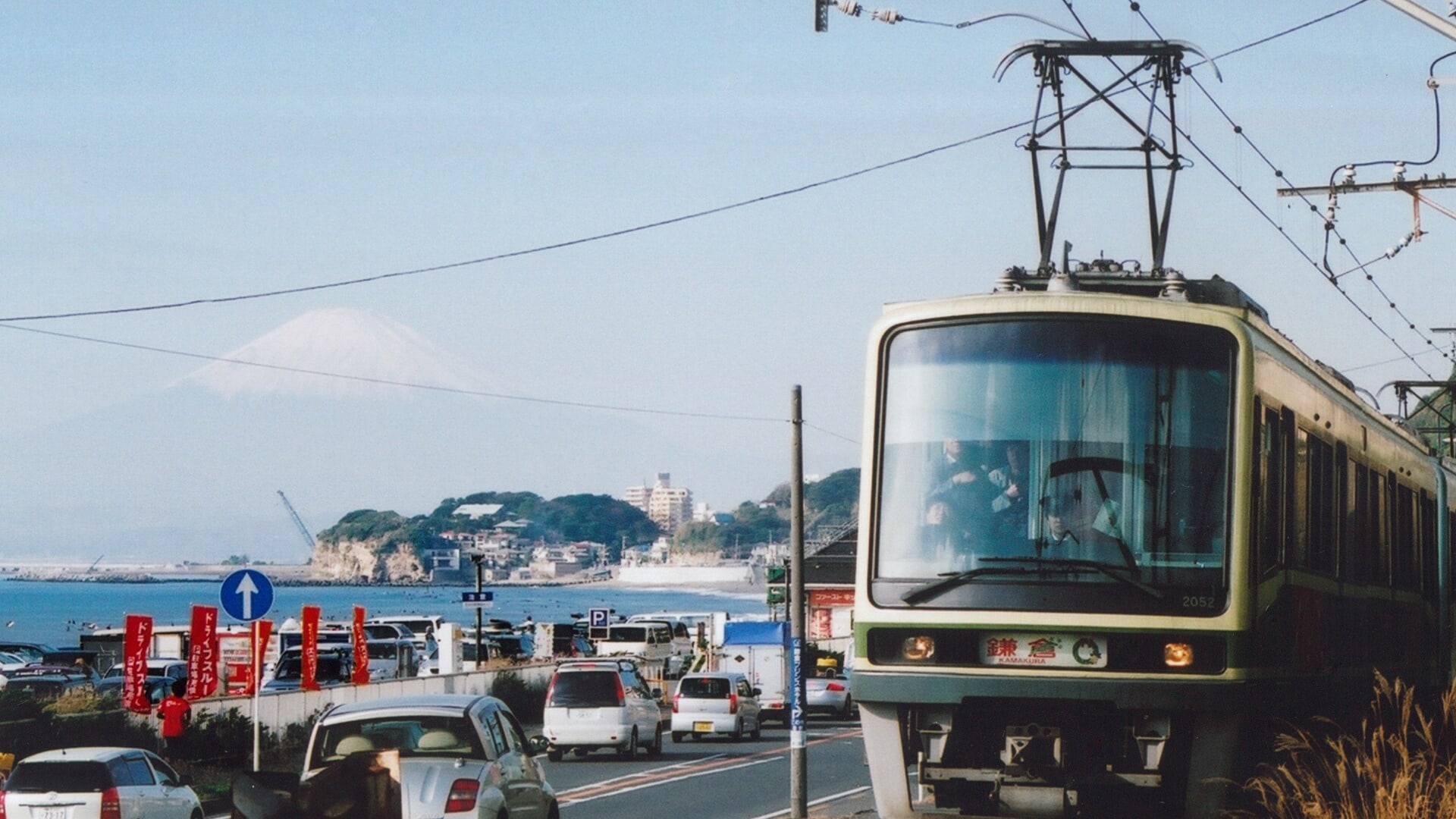
Header photo: an Enoden train on the Shonan coast with Mount Fuji behind it, photographed in 2026. Photo: Kirin7739, CC BY-SA 4.0 (cropped and resized). Source.
The Enoshima Electric Railway runs from Fujisawa to Kamakura in about thirty-seven minutes, the figure the operator publishes as a guide, past an island, a beach and two of Japan’s best known temples. The sea comes right up to the track on the stretch between Koshigoe and Shichirigahama. Halfway down it, beside Kamakurakokomae Station, is the level crossing from the opening sequence of the Slam Dunk television anime: the sea behind it, a green and cream two-car train sliding past. Shohoku High School is fictional and the manga never puts a real name on the map, so that crossing is the one connection solid enough to state plainly — and it is a working crossing on a public road between a coastal highway and a commuter railway, busy enough that Kamakura City has published a page about managing the visitors and set aside a park nearby for people who want a photograph. See the crossing first, then choose one of Enoshima or the Hase temples; two days is what it takes to do both without rushing either.
Quick Trip Guide
- Destination: Kamakura and Enoshima, Kanagawa Prefecture
- Best Gateway: Tokyo, by JR to Kamakura or Odakyu to Fujisawa
- From Gateway: About an hour from Tokyo Station to Kamakura; about an hour from Shinjuku to Fujisawa
- Main Base: Fujisawa or Katase-Enoshima for rooms and the railway; Kamakura for the temples
- Getting Around: The Enoshima Electric Railway, plus a great deal of walking
- Car Needed: No. A car is a liability here, and parking near the coast fills early
- Recommended Stay: 1 night, 2 days
- Day Trip: Yes, easily, from Tokyo or Yokohama
- Best For: Slam Dunk readers, railway travellers, and anyone who wants coast and temples in one day
Why This Place Matters
Slam Dunk is a basketball story about a red-haired delinquent who joins a school team to impress a girl and discovers, slowly and badly, that he is good at the game. Takehiko Inoue serialised it in Weekly Shonen Jump from 1990 to 1996, as his own official site records; Toei Animation turned it into a television series that ran from 1993; and in December 2022 Inoue wrote and directed The First Slam Dunk, which put the story back in cinemas for a generation that had only read it.
A story about getting better at something
What readers love is the growing. Sakuragi arrives with no skills and too much confidence, and the series spends its length making him, and the team around him, earn every small improvement — rebounds, footwork, being trusted with the ball. It is a story about ordinary teenagers in an ordinary Kanagawa school who become something more than that, and the coast in the anime’s opening is part of what makes the setting feel ordinary: a school-day train, the sea, a crossing you could walk past every morning.
Which Slam Dunk
The crossing comes from the opening sequence of the 1990s TV anime. The First Slam Dunk (2022), written and directed by Inoue, is a separate film; this guide does not attribute the crossing, or any scene at it, to the film.
Shohoku High School, where the team plays, is fictional. The manga places it in Kanagawa Prefecture and leaves it there. There is no official statement identifying a real school as its model, and this guide does not make one. What is not in question is a single piece of scenery: the opening sequence of the television anime shows a level crossing on the Enoshima Electric Railway with the sea beyond it, and that crossing is the one immediately beside Kamakurakokomae Station, on the stretch of coast between Koshigoe and Shichirigahama.
Thirty years later that one shot has turned a small roadside crossing into one of the most photographed spots in Kanagawa. Kamakura City has a page about it. The city manages the crowds there, and has had stewards at the station directing visitors to the adjacent Koshigoe Rakko Park and asking them not to stand still on the footway. Whether anyone is on duty on your day is not something to plan around: read the signs when you arrive, do what any staff there ask, keep off the carriageway and the track, and leave the footway and the crossing clear. What the city asks for is on its own page, in Japanese.
That is the honest shape of this trip. One crossing, five minutes of looking, and a coastline that rewards the rest of the day. The Enoden takes thirty-seven minutes end to end and passes a beach, an island with a shrine on it, the Great Buddha and a temple garden. You can treat the crossing as the reason you came and still spend nine tenths of your time somewhere else, which is what most people who enjoy this trip end up doing.
Where the connection is confirmed
- Confirmed: the crossing, the station and the railway along the coast, with the official requests that apply to all three.
- Not here: a real school named as Shohoku, a school gate to visit, or a photograph taken from the road itself.
- Not matched: individual frames to individual shopfronts. The crossing is the one place with a connection that can be stated plainly.
- Treated as a destination in their own right: Kamakura and Enoshima, which is where most of the day actually goes.
Anime Pilgrimage Spots
There is one pilgrimage spot here in the strict sense, and a short stretch of railway around it that gives the spot its setting. Everything else in this guide is sightseeing, and the guide keeps the two apart on purpose.
Please respect local rules and manners at every location, and follow signs and staff guidance.
Where these places are
The map shows the places below and how far apart they are. It is drawn with OpenStreetMap: opening it loads map images from openstreetmap.org. The list works without it.
The map could not be loaded. The places are listed below, with their names and a link to each on Google Maps.
- Anime-related places
- Station or transport
- Nearby sight
The 10 places on this map
- 1Kamakurakokomae Station and the crossing鎌倉高校前駅The Enoden coastIn this guideOpen in Google Maps
- 2Koshigoe fishing harbour, Rakko Park area腰越漁港The Enoden coastIn this guideOpen in Google Maps
- 3Shichirigahama七里ヶ浜The Enoden coast · area positionIn this guideOpen in Google Maps
- 4Tsurugaoka Hachimangu鶴岡八幡宮Kamakura templesIn this guideOpen in Google Maps
- 5Kotoku-in, the Great Buddha高徳院Kamakura templesIn this guideOpen in Google Maps
- 6Hase-dera長谷寺Kamakura templesIn this guideOpen in Google Maps
- 7Kamakura Station鎌倉駅Kamakura templesIn this guideOpen in Google Maps
- 8Enoshima江の島Enoshima · area positionIn this guideOpen in Google Maps
- 9Enoshima Aquarium新江ノ島水族館EnoshimaIn this guideOpen in Google Maps
- 10Fujisawa Station藤沢駅EnoshimaIn this guideOpen in Google Maps
Map data © OpenStreetMap contributors, ODbL. Positions were checked on 15 October 2026 against the source recorded for each place; a few are the published position for a large site rather than an entrance.
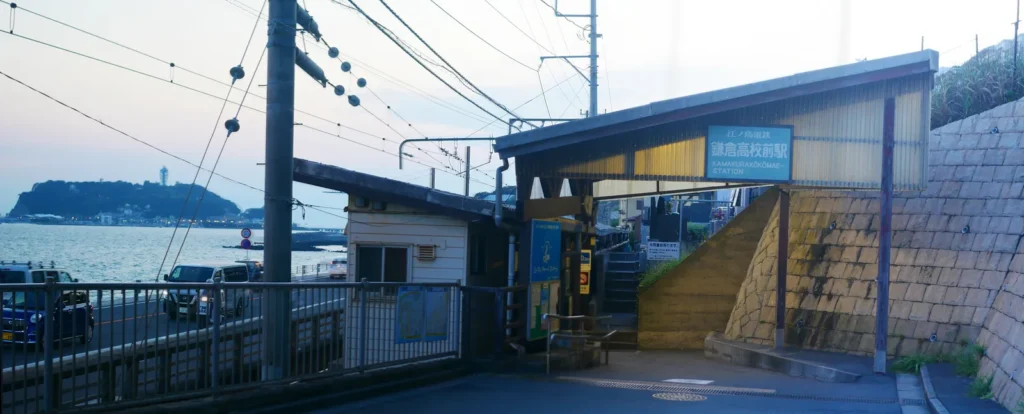
The level crossing by Kamakurakokomae Station
The crossing sits a few steps from the station exit, where a side road drops from National Route 134 down across the single track and towards the sea wall. Stand on the footway and you get the frame: rails, a crossing barrier, the horizon, and Enoshima off to the right. A train every few minutes completes it.
This is the crossing from the opening sequence of the television anime, and it is the only location in this guide whose connection can be stated as fact rather than as a popular identification. What is there is a standard Japanese level crossing on a public road: the Enoden single track, the sea wall and the Shonan coast behind it, with Mount Fuji on the horizon to the west in clear winter weather.
Fifteen minutes is generous, and the queue for the view is usually longer than the view. The Enoden reaches it from Kamakura in about twenty minutes for 260 yen, or from Fujisawa in seventeen minutes for the same fare. Standing at the barrier costs nothing, because it is a road.
The rules here are published and they are not optional. The carriageway and the track are not viewing platforms. Kamakura City asks visitors not to stop on the footway and directs photographers to Koshigoe Rakko Park nearby. Enoshima Electric Railway asks people to stay inside the yellow line on platforms, to use no flash or lighting, to bring no tripods or stepladders, never to enter the track, and not to photograph other passengers or local residents.
And the thing people get wrong: the high school the station is named after is a working school. It is not a sightseeing destination, its grounds are not open, and nothing in this guide asks you to go near it.
Kamakurakokomae Station itself
The station is worth the two minutes it takes to walk through. It is a tiny unstaffed-feeling halt dug into the hillside, with a platform that faces straight out over the water and almost nothing between the bench and the sea. On a clear evening the view from the platform is better than the view from the crossing, and nobody is standing in it.
The station is the setting the opening shot sits inside, and the reason the crossing looks the way it does: a single side platform facing straight out over the water, a corrugated station building above the steps, Route 134 and Enoshima across the bay. It is also the only place at this spot where you can wait comfortably, which matters more than it sounds when the crossing is three deep.
Give it ten minutes, or one train interval. There is no charge beyond a valid ticket. Platform space is narrow and the yellow line matters here more than at a large station — if the platform is full, take the next train rather than crowding the edge.
The coast between Koshigoe and Shichirigahama
The three stops either side of the crossing are the part of the Enoden that runs with the sea on one side and nothing much on the other, and they are the reason the opening sequence looks the way it does. At Koshigoe the railway runs down the middle of a shopping street, with cars pulling aside for a train the size of a bus. At Shichirigahama it climbs onto a ledge above a dark sand beach. The ride between them costs 200 yen and takes a few minutes, and it is a better anime pilgrimage than standing at the barrier.
The opening shot belongs to the stretch as a whole rather than to any single shopfront along it: scenery, not a checklist. The sand at Shichirigahama carries iron and reads almost grey from the window.
Ride it and sit on the sea side — the side the water is on along this stretch; the train swaps the view from window to window elsewhere on the line. A hop between the two stations costs 200 yen, or nothing extra on the Noriorikun day pass. Allow an hour if you break the journey once; Kamakura to Kamakurakokomae without stopping is 19 minutes by the operator’s table, and 20 in the other direction. Trains are two to four cars and fill from Kamakura outwards at weekends, so travelling towards Fujisawa in the morning is noticeably more comfortable — and happens to put the sun behind you for the sea views.
Koshigoe Rakko Park
This is the small neighbourhood park Kamakura City named as the place to send photographers, and the city put a bin there during the managed period because of litter around the crossing. It is an ordinary local park rather than an attraction, and it is mentioned here only because the city mentions it.
If the crossing is crowded and you want a photograph without standing in anyone’s way, this is the published alternative: a park near the station, used by local families.
How to Get There
Kamakura and Enoshima sit about fifty kilometres south-west of central Tokyo, on the far side of Yokohama, and three different railway companies will take you there. Which one you use depends on where you start and whether you want a pass.
From Haneda Airport
Haneda is the easier of the two Tokyo airports for this trip. Take the Keikyu Airport Line from the terminal to Yokohama, then change to the JR Yokosuka Line for Kamakura, or to the JR Tokaido Line for Ofuna and Fujisawa. Allow about an hour and twenty minutes door to door, more at the end of the working day, and note that the Keikyu platform at Yokohama is a long walk from the JR platforms with luggage.
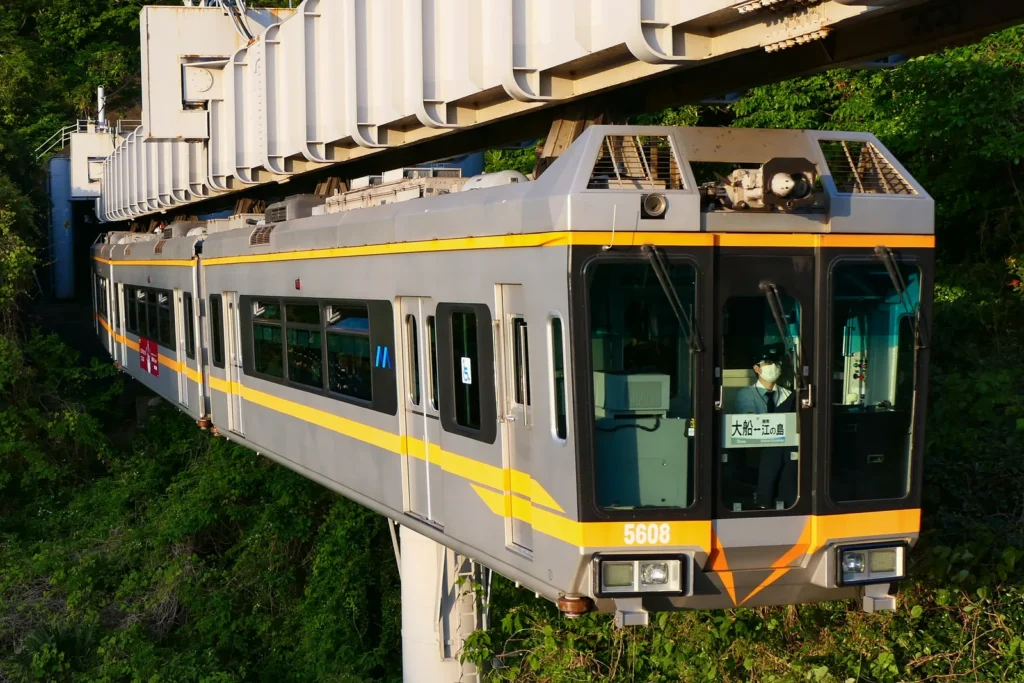
If you are heading for Enoshima rather than Kamakura, carry on to Ofuna instead and take the Shonan Monorail, which covers the remaining distance in fourteen minutes and is the most entertaining fourteen minutes of the journey.
From Narita Airport
The Narita Express runs beyond Yokohama to Totsuka and Ofuna on some services, which makes it the only one-seat ride from either airport towards Kamakura. From Ofuna it is one stop on the JR Yokosuka Line to Kita-Kamakura and two to Kamakura, or fourteen minutes on the monorail to Shonan-Enoshima. Check the service you want actually runs to Ofuna before you buy, because many Narita Express services terminate at Yokohama or turn north for Shinjuku.
From Tokyo and Shinjuku
- JR Yokosuka Line from Tokyo Station to Kamakura, direct, about an hour. The simplest option if you are starting on the east side of Tokyo.
- JR Shonan-Shinjuku Line from Shinjuku to Kamakura, direct on many services, about an hour. Check the destination board, because some services split or run to Zushi rather than Kamakura.
- Odakyu from Shinjuku to Fujisawa, about an hour on a rapid express, and the route to take if you want the Enoshima-Kamakura Free Pass. Romancecar services run to Katase-Enoshima on some days with a separate limited express charge.
- Odakyu to Katase-Enoshima, which puts you on the Enoshima side of the bridge rather than at Fujisawa, and is the right choice if the island is your first stop.
From Yokohama
Yokohama to Kamakura on the JR Yokosuka Line takes about twenty-five minutes, which makes Yokohama a realistic base if you want a big-city hotel and a small-town day. Yokohama to Ofuna is about fifteen minutes on the Tokaido Line, and from Ofuna the monorail reaches Shonan-Enoshima in fourteen.
Which station should you aim for?
- Kamakura if you want the temples first and the coast second. The Enoden starts here.
- Fujisawa if you want the full length of the Enoden, the cheapest rooms, and the Odakyu pass.
- Katase-Enoshima if the island is your priority. It is a short walk across the bridge.
- Ofuna if you are changing trains anyway and want the monorail.
Best Way to Get Around
The Enoshima Electric Railway, universally called the Enoden, is the spine of this trip. It is a single track running fifteen stations and ten kilometres from Fujisawa to Kamakura, through back gardens, down the middle of a street at Koshigoe, and along the sea wall past the crossing. Officially it takes thirty-seven minutes end to end.
Fares and times on the Enoden
Fares are zoned and short. The operator’s own table gives the following, all one way, adult then child:
- Fujisawa to Kamakura, the whole line: 310 yen and 160 yen, 37 minutes.
- Fujisawa to Kamakurakokomae: 260 yen and 130 yen, 17 minutes.
- Kamakura to Kamakurakokomae: 260 yen and 130 yen, about 20 minutes.
- Fujisawa to Enoshima: 220 yen and 110 yen, 9 minutes.
- Kamakura to Hase, for the Great Buddha: 200 yen and 100 yen.
- The lowest fare on the line is 200 yen and the highest is 310 yen.
Passes worth buying, and one that often is not
- Noriorikun, the Enoden one-day pass, is 800 yen for adults and 400 for children, valid only on the day it is issued, and sold at every Enoden ticket machine as well as through the EMot app. The railway’s own page for it lists the terms and the partner discounts, in Japanese. Whether it pays depends on the stretches you actually ride, not on how many times you board. Two common days, at the operator’s own adult fares: Kamakura to Kamakurakokomae (260), on to Enoshima (200) and back to Kamakura (260) is 720 yen, so singles come out 80 yen cheaper than the pass. Add Hase on the way back — Enoshima to Hase (260), Hase to Kamakura (200) — and the day is 920 yen, so the pass saves 120. Change the order or the station you finish at and the sum changes with it, so add up your own legs before you buy. Partner discounts are a separate question: work out the fares first, then see whether the discounts you would actually use close the gap.
- The Enoshima-Kamakura Free Pass from Odakyu costs 1,640 yen for adults and 430 yen for children from Shinjuku, and is valid for one day. It covers one return trip on the Odakyu line between your starting station and Fujisawa, unlimited travel on Odakyu between Fujisawa and Katase-Enoshima, and unlimited travel on the whole Enoden line. Prices differ by starting station: 1,180 yen from Machida and 1,040 yen from Yamato, for example. The Odakyu section is a single return, so plan to come back the way you went.
- The Shonan Monorail 1-Day Free Ticket (湘南モノレール1日フリーきっぷ) covers the whole monorail line, Ofuna to Shonan-Enoshima, for one day: 750 yen for an adult and 380 yen for a primary school child since the fare revision of 14 March 2026. It is the monorail only — it is not valid on the Enoden and has nothing to do with the Enoden’s Noriorikun. It comes as a paper ticket or as a QR ticket from the operator’s own ticket site, and since 8 April 2026 also in the Pass Case app, where it is adult only and is used by tapping the same contactless card or Apple Pay at the gate; a child’s pass is the 380 yen paper or QR version, not the app. If you are riding the monorail once each way, compare the pass with two ordinary tickets for your stations before you buy it.
On foot, and what not to bother with
Kamakura itself is a walking town. Tsurugaoka Hachimangu is ten minutes from the east exit of JR Kamakura, straight up the main approach. The Great Buddha is about ten minutes uphill from Hase Station, and Hase-dera is five minutes from the same station in the other direction. Enoshima is entirely on foot once you cross the bridge, with paid escalators if you would rather not climb.
Do not bring a car. Route 134 along the coast is slow at weekends, the car parks near Enoshima and Shichirigahama fill in the morning, and Kamakura City has spent years asking visitors not to stop near the crossing. A car turns a pleasant railway day into a parking problem.
A note on timing
- The Enoden is busiest from late morning to mid-afternoon at weekends and on public holidays, when the queue at Kamakura station can run outside the building.
- Going out early, towards Fujisawa, and coming back towards Kamakura in the evening works against the crowd rather than with it.
- The managed period at the crossing ran from 10:00 to 18:00, which is a fair indication of when it is busy even now that the scheme has ended.
- The coast faces south-west, so the light on the sea is best in the late afternoon, which is also when the trains are fullest. Pick one.
What to Eat
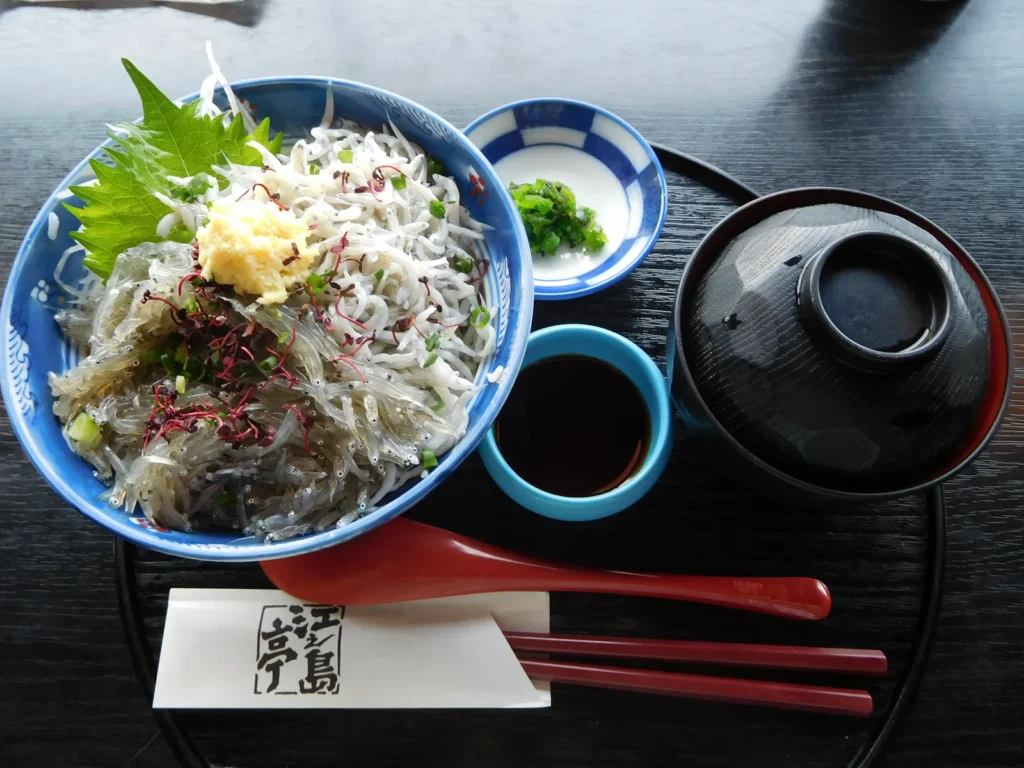
The Shonan coast has one signature ingredient and it is very small. Shirasu are the juvenile fish, mostly sardine, landed in quantity from the beaches between Enoshima and Koshigoe and served either raw or boiled on a bowl of rice. Everything else here is a Kamakura speciality rather than a coastal one.
Shirasu, and the one date that governs it
Kanagawa Prefecture closes the shirasu fishery from 1 January to 10 March. In that window raw shirasu, nama-shirasu, is simply not available anywhere honest, and restaurants that still list it are serving something frozen or something else. Boiled shirasu, kama-age, is available all year because it keeps. If raw shirasu is the reason you came, come between mid-March and December, and accept that even in season a day of bad weather means no landing and no raw shirasu that afternoon.
- Shirasu-don, a bowl of rice under a blanket of whitebait, often served half raw and half boiled so you can compare. This is the default lunch along the coast.
- Kama-age shirasu, boiled and faintly salted, mild and slightly sweet. The safe order in winter.
- Nama-shirasu, raw, translucent and faintly bitter, with ginger and soy. Only in season, only when the boats went out.
- Shirasu toast and shirasu pizza, which sound like a joke and are extremely common on this coast.
In Kamakura
- Kamakura vegetables, grown on the small farms inland from the town and sold at a producers’ market near the station. They turn up on local menus as a plain plate of grilled or raw vegetables, which is more interesting than it sounds.
- Komachi-dori, the shopping street running parallel to the approach to Tsurugaoka Hachimangu, is where the street food is: croquettes, soft serve, rice crackers and a great deal of matcha. It is crowded from late morning and pleasant at nine.
- Shojin ryori, the vegetarian temple cooking associated with Kamakura’s Zen temples, served at a handful of restaurants around Kita-Kamakura.
On Enoshima
- Tako senbei, a whole small octopus pressed flat between hot plates into a translucent cracker the size of a dinner plate. The queue on the shopping street is for this.
- Sazae no tsuboyaki, turban shell grilled in its own shell, sold from the stalls on the approach to the shrine.
- Whitebait again, in every form, because the fishing port is on the mainland side of the bridge.
Eating well on this coast
- Lunch is the main meal here. Many coastal restaurants close between lunch and dinner, and some close when the day’s catch runs out.
- The queues at the well-known shirasu restaurants near Enoshima run past an hour at weekend lunchtime. Eating at 11:30 or after 14:00 avoids most of it.
- Kamakura empties in the evening and a surprising number of restaurants shut by 20:00, so book if you want a late dinner.
- If you are travelling with someone who does not eat raw fish, boiled shirasu is the easy answer and is on every menu.
Things to Do Beyond the Anime
This is where the day actually goes. Kamakura was the seat of government in Japan for a century and a half and kept the temples to prove it; Enoshima is a small sacred island with a cave system, a lighthouse and a garden on top. Both were destinations long before the anime, and both are within the same day pass.
Tsurugaoka Hachimangu
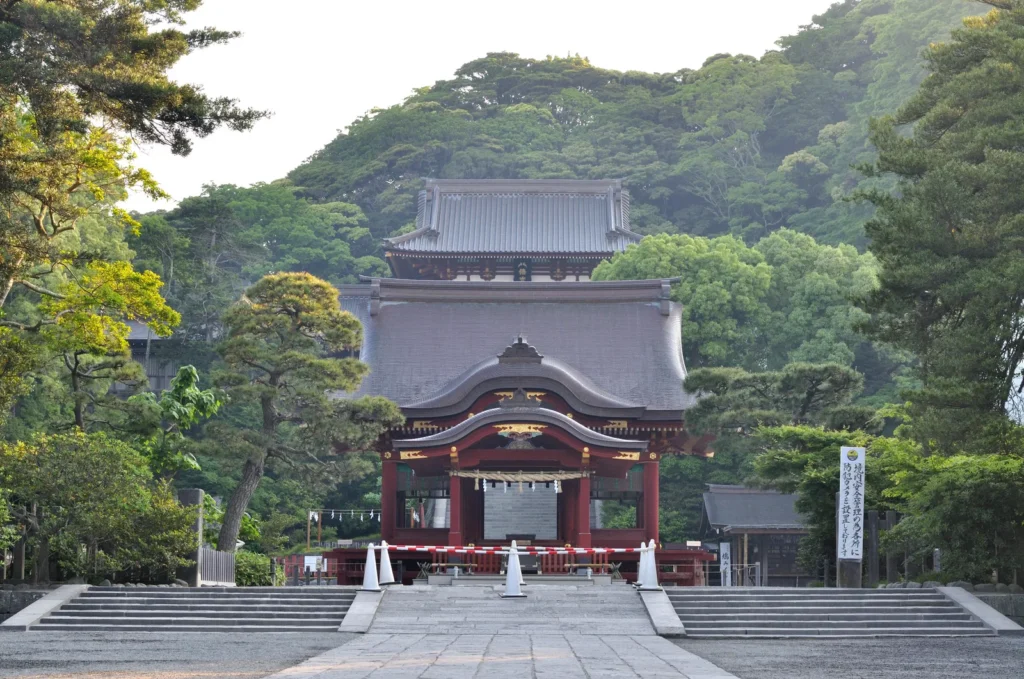
The shrine at the head of Kamakura’s main avenue, founded in the eleventh century and moved to its present site by Minamoto no Yoritomo when he made Kamakura his capital. The approach runs straight from the sea to the foot of the steps, which tells you most of what you need to know about how the town was laid out.
- Hours: the grounds are open 6:00 to 20:00 all year.
- Inside the grounds: the treasure hall opens 9:00 to 16:00, and the Kamakura Bunkakan Tsurugaoka Museum 10:00 to 16:30, closed Mondays except when a public holiday falls on one, and during exhibition changes and new year.
- Getting there: ten minutes on foot from the east exit of JR Kamakura Station, straight up Wakamiya-oji.
- How long to allow: an hour, or two if you go into the museum.
- Good to know: there is paid parking on site, but the approach is a pedestrian pleasure and the car park queue is not.
Kotoku-in and the Great Buddha
The bronze Amida Buddha at Kotoku-in has sat in the open air since the hall around it was destroyed in the fifteenth century, which is why it looks the way it does: weathered, green, and entirely unbothered. You can go inside it for fifty yen.
- Hours: 8:00 to 17:30 from April to September and 8:00 to 17:00 from October to March, with last entry fifteen minutes before closing. The inside of the statue is open 8:00 to 16:30 all year.
- Admission: 300 yen general, 150 yen for elementary, junior high and senior high school students, free for preschool children, and 50 yen extra to go inside the statue.
- Getting there: about ten minutes uphill on foot from Hase Station on the Enoden, which is 200 yen from Kamakura.
- How long to allow: forty-five minutes.
- Photography: personal photographs are fine. The temple prohibits drones anywhere in the grounds and selfie sticks inside the statue, and commercial shooting needs prior permission through its application form.
Hase-dera
Five minutes from the same station, built up a hillside in terraces, with a sea view from the upper level and a garden that is one of the better ones in Kamakura. The cave at the bottom of the site is low enough that most adults have to stoop.
- Hours: 8:00 to 16:30 with the gate closing at 17:00; from April to June 8:00 to 17:00 with the gate closing at 17:30.
- Admission: 400 yen for adults and 200 yen for elementary school children.
- Getting there: five minutes on foot from Hase Station.
- How long to allow: an hour.
- Good to know: the hydrangeas in June bring a timed-entry queue that can be very long. Any other month, walk straight in.
Enoshima
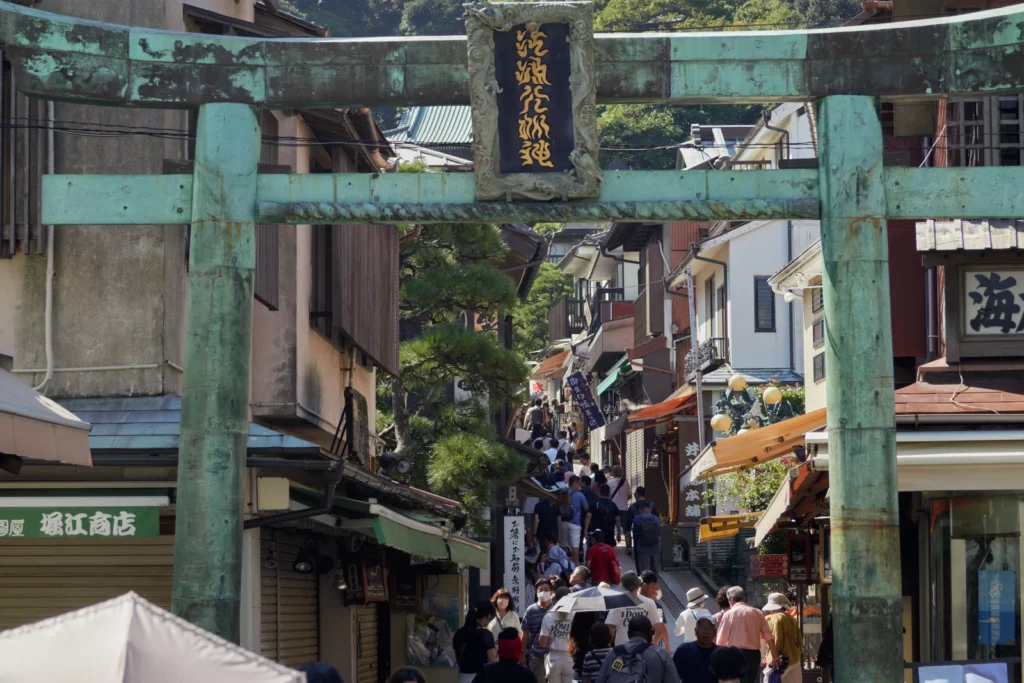
The island is a twenty minute walk from Katase-Enoshima Station across a road bridge, and goes almost straight up. A shopping street leads from the bronze torii to the first of three shrines, paid outdoor escalators carry you to the top if the steps are not appealing, and the far side drops to a rock shelf and a pair of sea caves.
- Escar: the three-stage outdoor escalator costs 500 yen for adults and 250 for children, and only goes up.
- Samuel Cocking Garden: free from 9:00 to 17:00, then 500 yen for adults and 250 for children in the evening.
- Sea Candle: the observation lighthouse is 800 yen for adults and 400 for children. A set ticket covering the garden, the tower and the escalators is 1,100 and 550.
- Iwaya Caves: 500 yen for middle school age and above and 200 yen for elementary school children, open 9:00 to 17:00 with seasonal variation. They close in rough weather, and the rock shelf below them is closed whenever the sea is up, however calm it looks from above.
- How long to allow: three hours for the island, four if you take the caves slowly.
- Good to know: combined passes covering several of these are also sold. Check the operator’s ticket page for what each one currently includes rather than assuming.
Enoshima also turns up in another series on this site: in episode 9 of Bocchi the Rock! the band takes a day trip to the island, and the episode is named after its escalator. If you are coming from Shimokitazawa, our Bocchi the Rock! guide has that day; the island is scenery in both stories rather than a shared location.
Enoshima Aquarium
On the mainland side of the bridge, facing the beach, and one of the better aquariums in the Tokyo area, with a jellyfish hall and a large Sagami Bay tank. Admission is 2,800 yen for adults, 1,800 for high school students, 1,300 for junior high and elementary school children and 900 for children aged three and over. Opening hours change several times a year, so check the date you are going.
Shichirigahama and the beaches
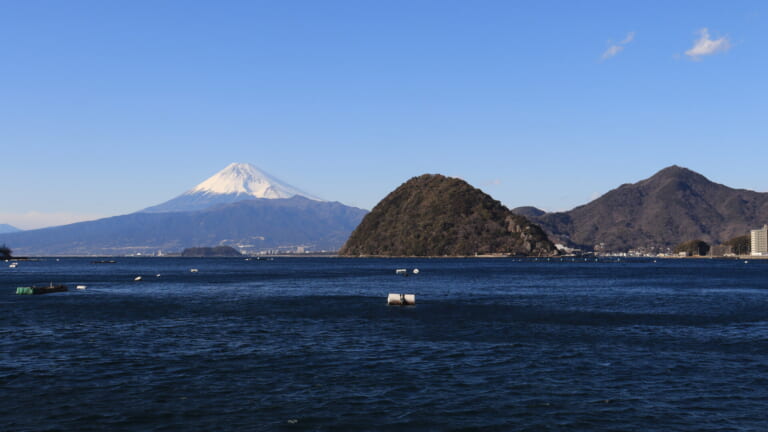
The beach below Shichirigahama Station is dark sand with iron in it, backed by the railway and Route 134, and used year round by surfers. It is a place to walk rather than a place to swim outside the short official bathing season, and the current along this coast is taken seriously by the people who live here. On a clear winter afternoon Mount Fuji sits directly across the water from it, which is the view on every poster of this coast ever printed.
What to Bring Home
Kamakura has been selling things to visitors for a very long time and is good at it. Nothing below is anime merchandise, because the officially licensed goods for this work are not sold at the crossing and the stalls near the station are ordinary local shops.
- Dove-shaped butter biscuits, the plain, slightly sweet shortbread that has been Kamakura’s standard gift for over a century. Sold at the station and along Wakamiya-oji, in tins that survive a suitcase.
- Dried and boiled shirasu, vacuum packed, sold at the fishing port shops and at Enoshima. Boiled shirasu keeps a few days refrigerated; dried keeps for months and is the practical one to fly with.
- Kamakura-bori, the local carved and lacquered woodware, made here since the Muromachi period. Expensive at the good shops and worth seeing even if you do not buy.
- Enoden goods, sold at Kamakura and Fujisawa stations: the green and cream livery turns up on everything from towels to biscuit tins, and it is the most honest souvenir of this particular trip.
- Enoshima shell work and tako senbei, from the stalls on the shrine approach. The crackers are best eaten the same day.
- Matcha and wagashi, from the long-established tea shops around Komachi-dori.
Buying sensibly
- Most food souvenirs here have short shelf lives. Check the date on the box before you buy something for a long flight.
- The station shops at Kamakura and Fujisawa carry a good selection and stay open later than the street shops.
- Kamakura-bori is a protected local craft with a wide price range. Ask whether a piece is hand carved before paying hand-carved prices.
- Raw and boiled seafood is subject to import rules in many countries. Dried products are the safer choice if you are flying home.
Where to Stay
Kamakura has fewer hotel rooms than its visitor numbers suggest, and they book out at weekends and in the hydrangea and autumn colour seasons. Fujisawa, Katase-Enoshima and Ofuna are all within the same day’s travel and considerably easier to book.
Fujisawa and Katase-Enoshima
The practical base. Fujisawa is a full-sized station town with business hotels, a shopping centre and three railway lines, and it is one end of the Enoden, so you can start the line from the beginning in the morning. Katase-Enoshima puts you a bridge away from the island and is quieter at night.
On Enoshima itself
The island has a small number of inns, several of them long-established, and the official Fujisawa tourism site lists them: the Enoshima Hotel, the ryokan Iwamotoro Honkan just over the bridge, Ebisuya on the shrine approach, and the small family-run guesthouses Ogawatei and Kaijotei. Staying on the island means climbing to your room and having the place largely to yourself after the last day visitors leave, which is the main reason to do it.
Kamakura
Best if your interest is the temples and you want to be out at Tsurugaoka Hachimangu before the coaches. Expect higher prices, a small number of rooms, and almost nothing open late. Kita-Kamakura, one stop north, is quieter again and close to the Zen temples.
Ofuna and Yokohama
Ofuna is a transport junction with cheap rooms, fourteen minutes from Shonan-Enoshima on the monorail and one stop from Kita-Kamakura. Yokohama is twenty-five minutes from Kamakura by JR and has the largest choice of hotels in the region by a wide margin, which makes it the sensible base if you are combining this trip with anything else.
Choosing a base
- First time, one night: Fujisawa. Cheap, well connected, and at the start of the railway.
- Temples first: Kamakura or Kita-Kamakura, booked well ahead.
- Island and sea: Katase-Enoshima, or an inn on the island itself.
- Travelling on afterwards: Yokohama, and treat the whole coast as a day trip.
Suggested Itinerary
There is exactly one Slam Dunk location here, and it takes fifteen minutes. Everything else is Kamakura, Enoshima and a very good little railway, which is why this trip is sized by the time you have rather than by a list of spots.
| You have | Two hours | Half a day | A full day |
|---|---|---|---|
| Do | Enoden to Kamakurakokomae, the crossing, the platform, back | Add the coast: break the ride at Koshigoe and Shichirigahama | Add Kamakura or Enoshima, not both properly |
| Tickets | Two singles, 520 yen from Kamakura | Add up the legs you will actually ride and compare with the 800 yen pass | Crossing, Enoshima and back to Kamakura is 720 yen in singles; add Hase and it is 920, where the 800 yen pass wins |
| Best timing | Avoid weekend afternoons | Morning, travelling towards Fujisawa against the flow | Crossing first, sightseeing after |
| Weather | Fine either way | Clear winter days put Fuji on the horizon | Rain pushes you into Kamakura’s temples, which is no hardship |
Two days covers the coast and the temples without rushing either. One day covers the crossing and about half the rest, which is what most visitors from Tokyo actually do.
Day 1: the coast
- Morning. Arrive at Fujisawa. Buy the Noriorikun day pass at the station machine, or arrive on the Enoshima-Kamakura Free Pass from Shinjuku. Take the first Enoden towards Kamakura and sit on the sea side.
- 09:30. Kamakurakokomae. Walk through the station to the platform, look at the sea, then go up to the crossing before the busiest hours begin. Fifteen minutes is enough. Stay on the footway, keep moving, and let people past.
- 10:15. One stop to Shichirigahama and walk down to the beach. On a clear day Mount Fuji is straight out across the water.
- 12:00. Back towards Enoshima for lunch. Shirasu-don, raw if it is between mid-March and December and the boats went out.
- 13:30. Cross the bridge to Enoshima. Shopping street, the first shrine, the escalators or the steps, the Sea Candle, then down the far side to the Iwaya Caves.
- 17:00. Back across the bridge. If the sky is clear, the sunset from the bridge or the beach is the best thing you will see all day.
- Evening. Dinner in Fujisawa or Katase-Enoshima.
Day 2: the temples
- 08:30. Enoden from Fujisawa to Hase. The line is empty this early and the ride along the coast is the whole point.
- 09:00. Kotoku-in for the Great Buddha, which opens at 8:00 and is quiet for the first hour. Pay the extra fifty yen and go inside.
- 10:15. Hase-dera, five minutes away, for the terraces and the sea view.
- 12:00. Enoden to Kamakura, which is the end of the line. Lunch on or around Komachi-dori.
- 13:30. Walk up Wakamiya-oji to Tsurugaoka Hachimangu. An hour in the grounds, longer with the museum.
- 15:30. Komachi-dori for souvenirs, or the JR to Kita-Kamakura for the Zen temples if you have the energy.
- 17:00. JR from Kamakura back to Tokyo, about an hour.
If you only have one day
Do the crossing first, then pick one sightseeing area rather than two. Start at Fujisawa, take the first Enoden of the morning to Kamakurakokomae, give the crossing and the platform fifteen minutes, and then choose: Enoshima for the island, the caves and the sunset from the bridge, or Hase for the Great Buddha and Hase-dera. Either choice means missing the other and Tsurugaoka Hachimangu, which is the easiest of the three to come back for.
If you would rather see the temples first — they are quietest early, and the Great Buddha opens at 8:00 — that is a fair trade, but it puts the crossing in the early afternoon, which is the busiest part of the day there. Take that version on a weekday, and expect to wait for a gap on the footway at the weekend.
Timing that makes the difference
- Be at the crossing before 10:00 or after 17:00. The middle of the day at weekends is unpleasant.
- The Great Buddha opens at 8:00, earlier than almost anything else in Kamakura. Use it.
- The last Enoden from Kamakura runs late enough for dinner, but the restaurants close before it does.
- In June, add an hour to anything involving Hase-dera. In August, add water.
Travel Tips & Etiquette
More than any other route in this series, this one comes with rules that are not ours. Kamakura City, the railway and the people who live beside the crossing have all asked for specific things, and they asked because enough visitors did the opposite.
At the crossing
- Stay off the carriageway and off the track. The road carries cars down from Route 134 and the track carries trains every few minutes. Enoden asks people never to enter the track, and that is not a formality.
- Do not stop still on the footway. This is the specific request Kamakura City makes of visitors here. The footway is narrow and it is how people reach the station.
- Use Koshigoe Rakko Park if you want to linger. It is the place the city named for exactly this purpose.
- No tripods and no stepladders. Enoden asks for this directly, on safety grounds.
- No flash. It interferes with train operation, which is why the railway lists it.
- Do not photograph other visitors or residents. Enoden asks people to refrain from shooting when other passengers or neighbours are in the frame.
- Take your rubbish with you. Litter was one of the two problems the city measured during its trial.
- Do not enter private land. The houses above and beside the crossing are people’s homes, and the drives are not viewpoints.
About the school
- The station is named after a high school across the road. It is a working school with students in it.
- It is not a sightseeing destination, its grounds are not open to visitors, and this guide does not include it as a stop.
- Nothing in the anime requires you to go anywhere near it. The crossing is on the public road, and that is the whole of it.
- If you find yourself at a school gate on this trip, you have gone the wrong way.
On the railway
- The Enoden is a commuter line first. It carries schoolchildren and people going to work, and at peak times it is full before it reaches the tourist stops.
- Let people off before boarding, and move into the car rather than standing by the door. The cars are short and the doorways are the whole bottleneck.
- Large luggage is a problem on two-car trains at weekends. Use the station lockers at Kamakura or Fujisawa.
- IC cards work on the Enoden, the monorail, Odakyu and JR, so a Suica or Pasmo covers the whole trip except the day passes.
- The Noriorikun pass is paper or digital, and the paper version is shown to staff rather than tapped. Allow a few extra seconds at the gate.
General
- Weekends and public holidays are a different trip from weekdays here, in a way that is hard to overstate. If you have any flexibility, come midweek.
- Weather closes things. The Iwaya Caves and the rock shelf below them shut when the sea is up, and typhoon season from August to October can close the Enoshima facilities at short notice.
- The sea here is not a swimming pool. Outside the short official bathing season, with lifeguards, the currents along this coast are a genuine hazard.
- Cash still matters at small shops and shrine offices, though the stations, the big attractions and most restaurants take cards.
- Temples and shrines are places of worship. Keep your voice down in the inner precincts, and look for the signs that mark where photography is not permitted.
Plan Your Trip
If you are building a longer trip around anime locations, these connect naturally with it:
- Your Name in Hida, Gifu, a mountain town with a canal and a UNESCO-listed festival, reachable from Nagoya.
- Love Live! Sunshine!! in Numazu, Shizuoka, another coastal town an hour and a half further down the same stretch of sea.
- Yuru Camp in Yamanashi and Shizuoka, for Mount Fuji from the other side.
- Initial D in Gunma, mountain passes two hours north of Tokyo.
- Detective Conan in Hokuei, Tottori, and ONE PIECE in Kumamoto, for a longer trip west.
- Attack on Titan in Hita, Oita, the author’s home town in Kyushu.
How this guide was put together
This guide was researched and planned from published sources rather than written up from a visit. Checked on 12 October 2026: Enoshima Electric Railway’s own fare and journey-time table for every fare quoted here, its Noriorikun day-pass terms, and its published requests to photographers; Kamakura City for the request not to stop on the footway at the crossing and for the direction to Koshigoe Rakko Park; and Odakyu for the Enoshima-Kamakura Free Pass price and what it covers.
The Shonan Monorail day-pass price is now quoted: it was added on 13 October 2026 from the operator’s fare-revision Q&A (updated 25 December 2025, prices effective 14 March 2026) and its notice of 6 April 2026 about the Pass Case version; an earlier version of this guide said the price was not published, because only the pass’s own description page had been read. The pass-versus-singles comparison uses the actual segments in the itineraries rather than a generic claim, and the timings are planning estimates.
Written and edited by Nick, who runs Anime Routes Japan from Japan. More about Nick, and about how these guides are made, is on the About page.
The practical details here — opening hours, fares, access and the operators’ own requests — were checked against official sources on 5 October 2026: Kamakura City, Enoshima Electric Railway, Odakyu, Shonan Monorail, Fujisawa City’s tourism office, Kanagawa Prefecture, and the individual temples and facilities. Opening hours, fares and the crowd measures at the crossing all change. Check the operator or the facility before you travel, and treat the requests at the crossing as standing whether or not anyone is there to repeat them.
This guide currently contains no affiliate links.