anohana Pilgrimage Guide to Chichibu, Saitama, Japan
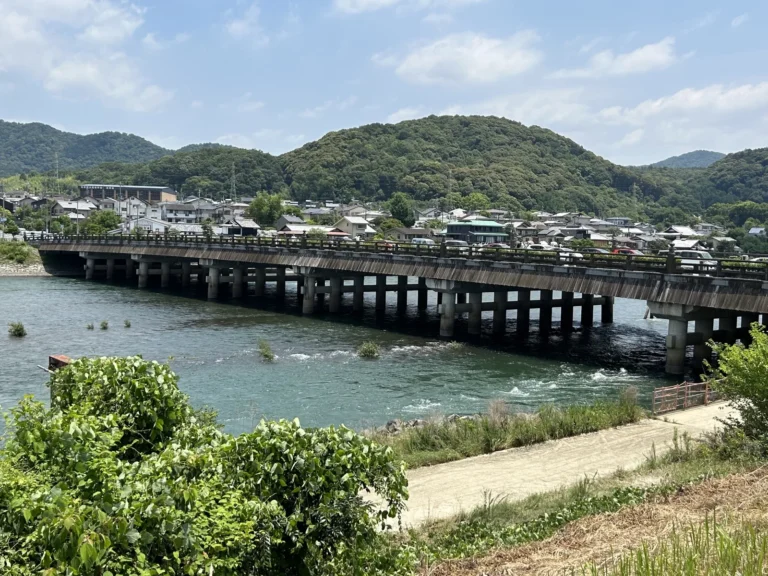
Header photo: the view from the old Chichibu Bridge toward the new Chichibu Bridge over the Arakawa. Photographed in May 2011. Photo: I_LOVE_WIKI, CC BY-SA 3.0 (cropped and resized). Source.
All of it happens in Chichibu, a mountain-ringed town ninety minutes from Ikebukuro in western Saitama. The series came out in 2011 and turned the place into one of the first and most durable anime pilgrimage destinations in Japan, and Chichibu City has kept the project going ever since — maps, stamp rallies, anniversary events, and a tourism site that still lists the locations fifteen years on. What makes it work is that the locations are not landmarks. They are a small temple, a bridge, a street and a riverbank: the ordinary places six children would actually have used. The temple, the bridge and the town centre are one walk; Shimo-Yoshida is an add-on with its own bus and its own half-day.
Quick Trip Guide
- Series: anohana: The Flower We Saw That Day (あの日見た花の名前を僕達はまだ知らない。), TV series 2011, film 2013
- Where: Chichibu, western Saitama
- Getting there: Seibu Laview limited express from Ikebukuro to Seibu-Chichibu, fastest 77 minutes
- Main locations: Jorin-ji, the old Chichibu Bridge, Banba-dori, Chichibu Shrine, Keyaki Park
- Who names them: Chichibu City’s own tourism service. The official synopses name no real places
- Time needed: One day on foot covers the town. A second day reaches Shimo-Yoshida
- Best season: Any. Spring for flowers, summer for the river, December for the night festival
- In 2026: The Chichibu pilgrimage is in its once-in-twelve-years Horse year, to 30 November
- Budget: Low. The walk is free; the temples ask only for respect
Why Chichibu Matters in anohana
anohana: The Flower We Saw That Day is about six childhood friends who stopped being friends, and about the one of them who does not get older. Jinta has withdrawn from school and from everybody. Menma turns up in his room and asks him to grant a wish she cannot remember the details of. Working out what the wish was means finding the other four, which is the part nobody wanted to do.
Six children who called themselves the Super Peace Busters
The official introduction is blunt about it: they were childhood friends, and by high school they had drifted apart. Jinta has stopped going to school. Anaru has gone along with a group she does not much like. Yukiatsu and Tsuruko are at an academic high school. Poppo did not go on to high school at all and travels instead. And Menma, the official page says, is the one who has not changed while everyone else has.
She appears in Jinta’s room and asks him to grant a wish. He cannot grant it because nobody — including her — can remember what it was. Working it out means going to the old meeting place, and then going to find the other four, which is the thing they have all spent years avoiding. The episode titles alone sketch the shape of it: the secret base, a tunnel, a steamed bun that proves something, and finally fireworks.
Why that makes Chichibu worth a day
Because the places are the point. This is not a story that needed a castle or a famous view; it needed somewhere six children could have cycled to, argued in and then stopped visiting. So the locations are a small hillside temple, a concrete bridge over a wide shallow river, a street of old shopfronts, and a riverbank. Standing in them is less about matching a frame than about understanding why a group of kids would have chosen them.
Chichibu understood that early. The city has run anime pilgrimage projects here since 2011 and is still running them: it calls anohana, Kokosake and Sora no Aosa its “Chichibu trilogy”, hands out maps at five information points, and puts on anniversary events. You arrive to find the town is expecting you.
TV series or film
The TV series ran in 2011, eleven episodes. A film followed in 2013, and it is a separate work. This guide refers to the TV series. Nothing below spoils how it ends, and the parts of the story that would be spoilers are left out on purpose.
Who attributes these locations
- The official episode synopses do not name a single real place. Every location below is attributed to Chichibu City’s own tourism service, which names them on its anime course page (Japanese), its rental-cycle map and its audio-walk pages. That course is a joint one covering two works, so check the marker beside each stop.
- For the same reason, this guide does not pair a location with an episode number. No official source does, and the ones you will find elsewhere are fan attributions.
- We do not identify anybody’s house, or the secret base. They are not on the city’s list, and the places people point at are ordinary private property.
- The 2026 fifteenth-anniversary events have finished: the stamp rally ran 10 April to 17 May 2026 and actually closed early, on 5 May, when the badges ran out, and applications for the September screening closed on 31 July 2026. Check the city’s anime page for what is running when you travel.
- Everything was checked on 12 October 2026 against the work’s official site and the city’s own pages.
Anime Pilgrimage Spots
All of these are marked by Chichibu City as anohana locations. The first four are one walk; the last two need transport and a decision.
Please respect local rules and manners at every location, and follow signs and staff guidance.
Where these places are
The map shows the places below and how far apart they are. It is drawn with OpenStreetMap: opening it loads map images from openstreetmap.org. The list works without it.
The map could not be loaded. The places are listed below, with their names and a link to each on Google Maps.
- Anime-related places
- Station or transport
- Nearby sight
The 6 places on this map
- 1Jorin-ji定林寺Central ChichibuIn this guideOpen in Google Maps
- 2The old Chichibu Bridge秩父橋Central ChichibuIn this guideOpen in Google Maps
- 3Chichibu Shrine and Banba-dori秩父神社Central ChichibuIn this guideOpen in Google Maps
- 4Seibu-Chichibu Station西武秩父駅Central ChichibuIn this guideOpen in Google Maps
- 5Hitsujiyama Park羊山公園Central ChichibuIn this guideOpen in Google Maps
- 6Shimo-Yoshida, the rocket festival area吉田町Further out · area positionIn this guideOpen in Google Maps
Map data © OpenStreetMap contributors, ODbL. Positions were checked on 15 October 2026 against the source recorded for each place; a few are the published position for a large site rather than an entrance.
Jorin-ji (Chichibu pilgrimage temple 17)
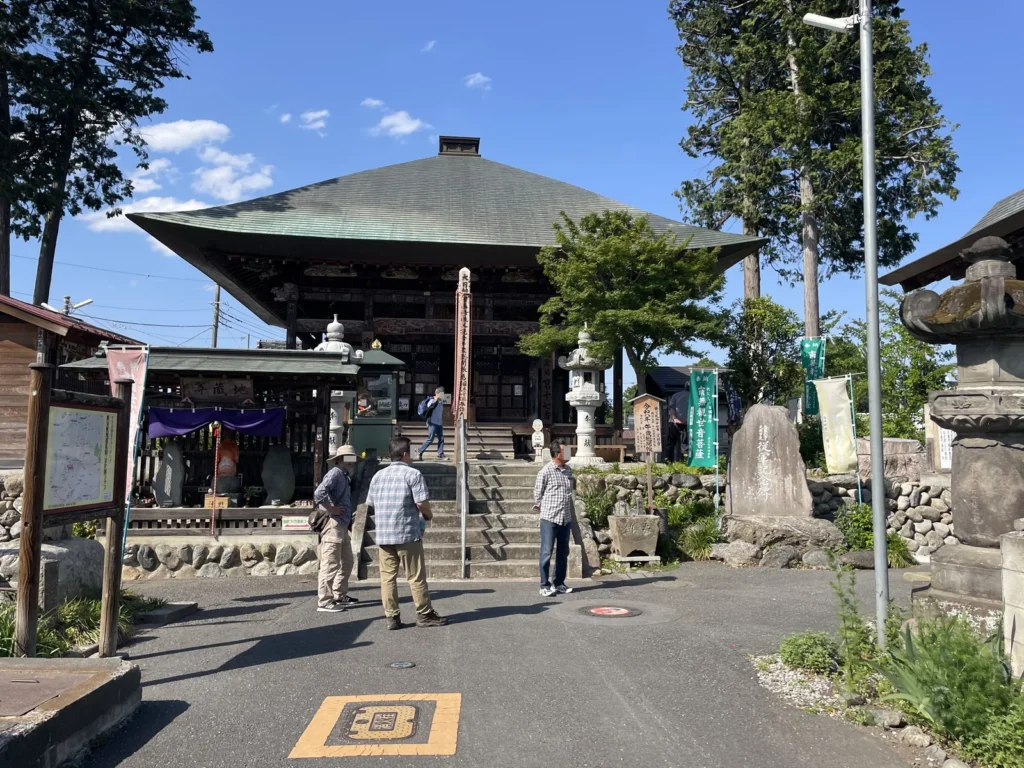
The single most recognisable anohana location and the first stop for most people who come: a small working temple on the edge of the town centre, with a wooden hall, a short flight of steps and a bell — exactly the kind of place a group of children would have adopted as their own. Its other identity is Jisshozan Jorin-ji, the seventeenth temple of the Chichibu Kannon pilgrimage, at 21-3 Sakuragicho. It is a place of worship first and a location second, and it is small.
In 2026 there is a reason to go beyond the series. The Chichibu pilgrimage is in its Horse year, so the once-in-twelve-years special opening runs to 30 November 2026, with stamp reception 8:00 to 17:00 and a break from 12:00 to 12:30. It sits in the walkable centre between Chichibu Station and Seibu-Chichibu, and on the city’s own rental-cycle route.
Keep your voice down, do not photograph people at prayer, do not leave anything behind, and do not go in the early morning or after dark. Residents live next to it.
The old Chichibu Bridge
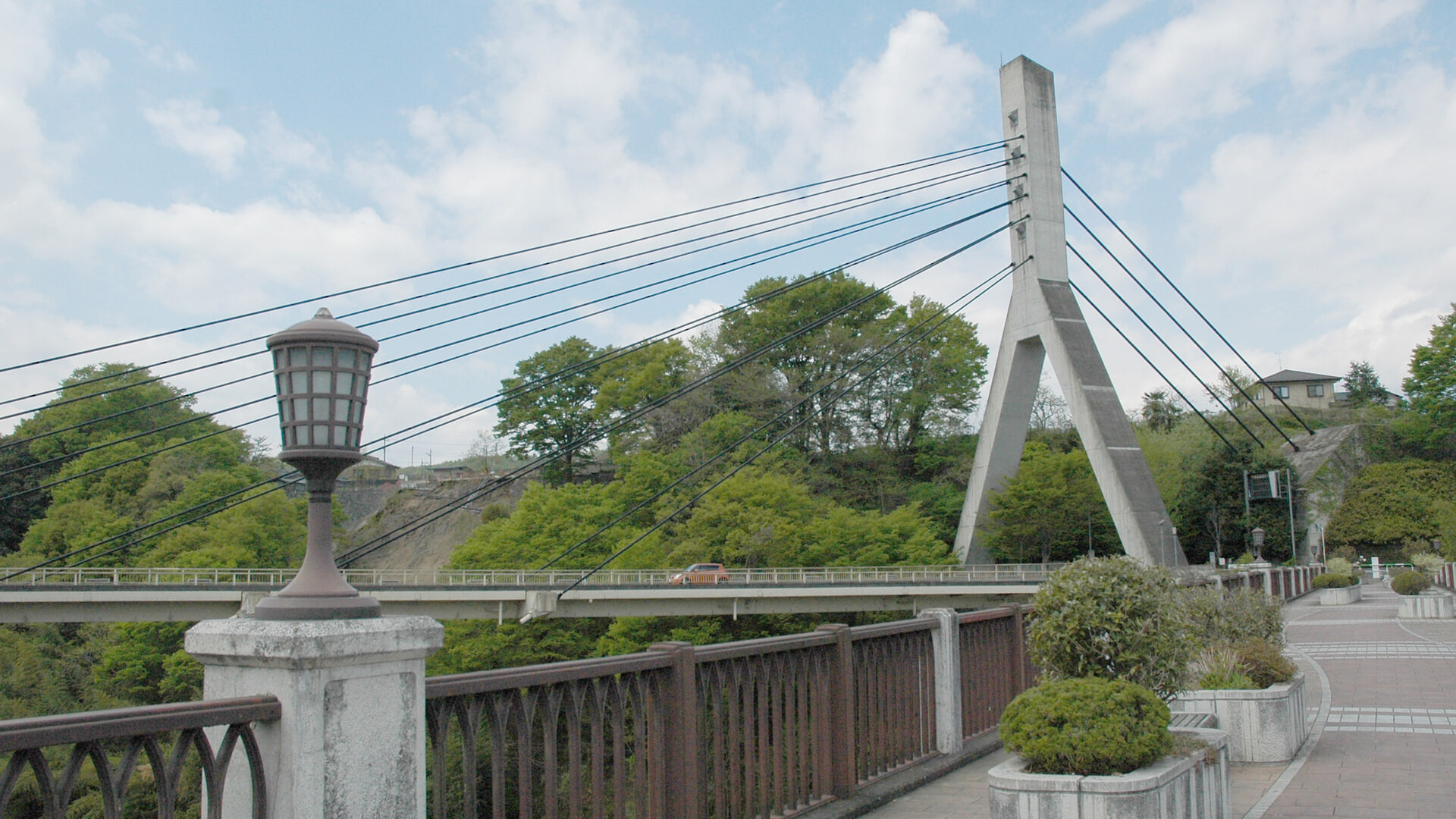
The bridge over the Arakawa is the image most people carry away from the series, and it helps to know which bridge is which before you set out. The old bridge is the pedestrian one, with the lamp standards and the iron railing; the new bridge, cable-stayed and white, is the one you look at from it. The featured photograph at the top of this guide is that exact view: a wide shallow river in a stony bed, hills on both sides, and two bridges of completely different centuries in the same frame.
It is the one central stop that is not a short walk. It lies north of the town centre, about half an hour on foot from Chichibu Station, or quickly by bus or bicycle; the city’s own routes include it. If your day is short, this is the one to reach by bicycle rather than to cut.
It is a public bridge on a public road and people cross it to get somewhere. Stand to one side, and do not set up in the middle of it.
Banba-dori and Chichibu Shrine
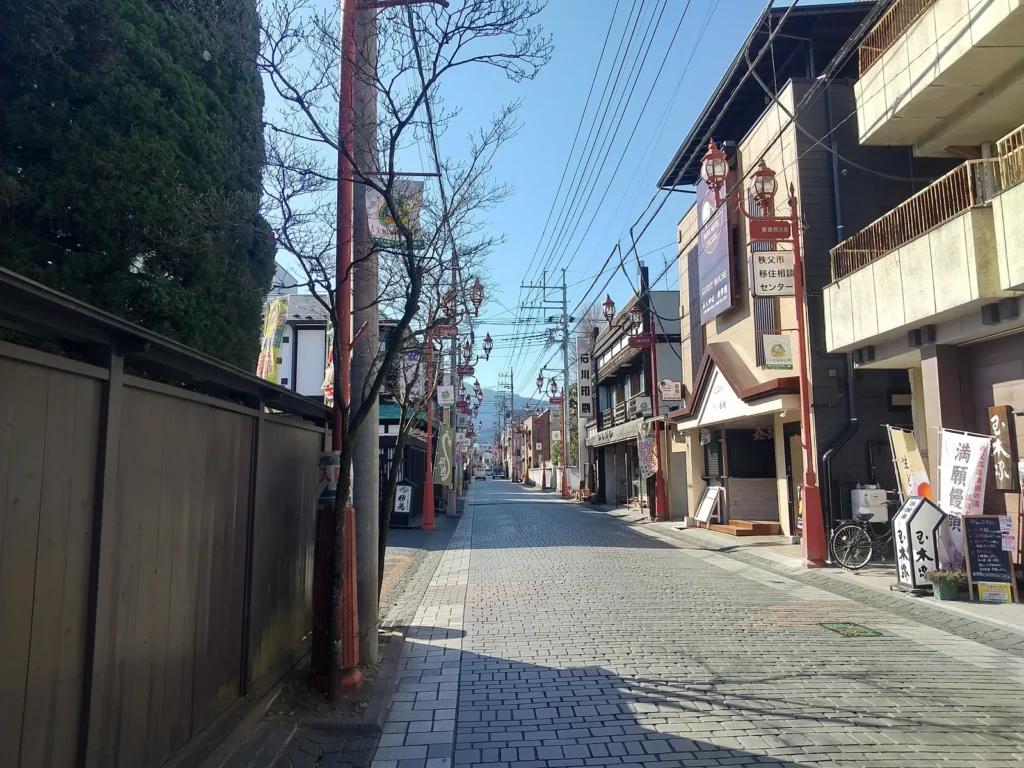
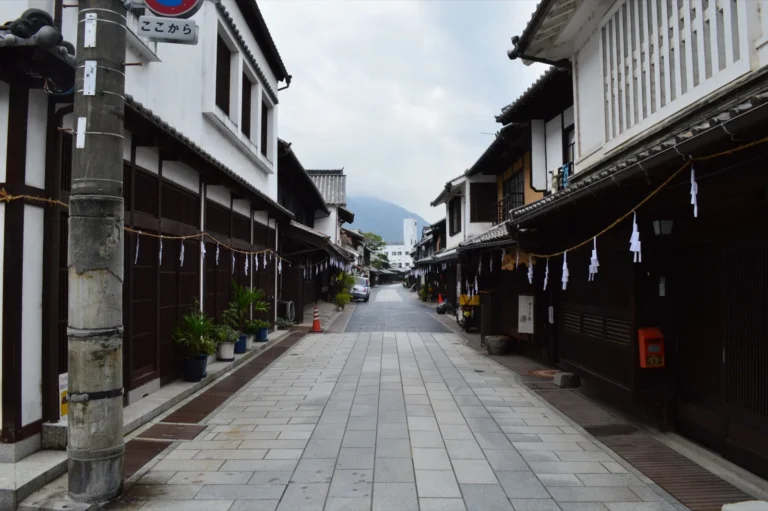
Banba-dori is the paved street alongside the shrine, lined with pre-war shopfronts and old-fashioned lamps, and it is the best-preserved piece of the old town. It runs straight into Chichibu Shrine, which is both a location on the city’s list and the centre of the Chichibu Night Festival in early December — a float festival with fireworks that is one of the biggest winter events in the Kanto region.
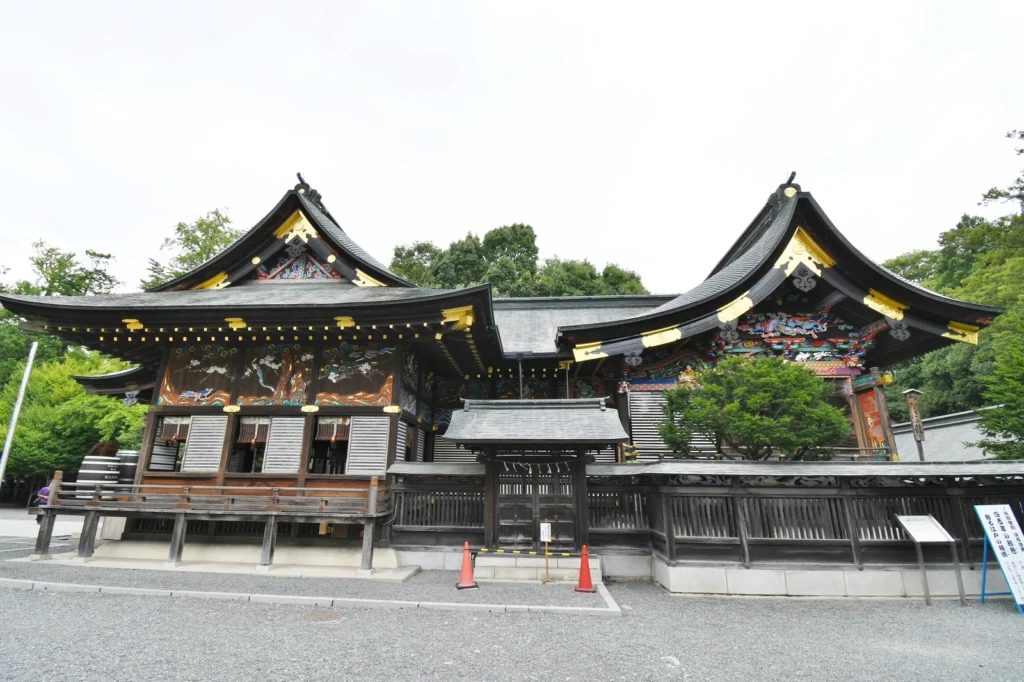
Treat these two as one stop. Twenty minutes gets you the length of the street and the shrine’s carvings; an hour gets you the shops as well.
Hot Spot Chichibu-kan, the history museum and Keyaki Park
- Hot Spot Chichibu-kan — a former inn on the old street, now a rest stop and information point, marked on the city’s course for both anohana and The Anthem of the Heart. One of the places that hands out the anime maps.
- Chichibu History and Culture Museum — also an information point for the anime maps, and a reasonable place to understand why the town looks the way it does.
- Keyaki Park — named on the city’s rental-cycle map as an anohana spot, and a short detour from the central walk.
Further out: Shimo-Yoshida and the rocket festival
Chichibu’s pilgrimage course also reaches Ryusei Kaikan out at Shimo-Yoshida, marked on it as an anohana location. It is the museum for the ryusei rocket festival held at Muku Shrine, where home-made black-powder rockets are fired from a wooden tower and climb some 300 metres with a noise you feel. The museum is closed on Tuesdays and is open all year, which matters because the festival itself is one day.
The festival is a single Sunday in October and the date moves. The 2026 edition ran on 11 October, from 8:40 until the thirtieth rocket had gone up, which the organisers expected at about 16:45. The following year’s date had not been published when this guide was checked, so do not assume one. One detail worth carrying over whatever the date: in 2026 there was no special bus from Seibu-Chichibu Station, and the organisers directed visitors to the special bus from Minano Station on the Chichibu Railway instead — walk from Seibu-Chichibu to Ohanabatake, take the Chichibu Railway to Minano, then the bus. Drivers were pointed at the Midorigaoka industrial estate car park, which has a free shuttle every fifteen to thirty minutes and does not take pets.
The same course visits Daiji-ji, the tenth pilgrimage temple — but it is marked there for The Anthem of the Heart, the second film of the Chichibu trilogy, not for anohana. If that film interests you it is a worthwhile stop in its own right. It is not in Chichibu city at all: the address is 5151 Yokoze, Yokoze town, the next stop out towards Tokyo. The temple’s own access page gives a Seibu Kanko bus from Seibu-Chichibu Station bound for Sadamine or Minano via Chichibu Station, getting off at the Fudasho 10 stop for a two-minute walk; on foot it is about 20 minutes (1.5 km) from Yokoze Station, or about 28 minutes (2.0 km) from Seibu-Chichibu Station.
These are a second day, not an afternoon
- Shimo-Yoshida is a bus ride of around half an hour from the town, on a route with a thin timetable.
- Check the return bus before you go out, not after.
- If you have one day, skip both. The four central stops are the trip.
How to Get to Chichibu
Ninety minutes from Ikebukuro, and the only thing you have to get right is which station.
By Seibu from Ikebukuro
- Laview limited express to Seibu-Chichibu, fastest 77 minutes. Every seat is reserved, so a limited-express ticket is needed on top of the ordinary fare; tickets go on sale a month ahead, online or at the station, and boarding without one costs more.
- Ordinary trains cover the same route for the basic fare with a change at Hanno. Slower and perfectly fine.
By JR and the Chichibu Railway
JR to Kumagaya, then the Chichibu Railway up the valley to Chichibu Station. Longer, but it delivers you to the station nearest the shrine and the old street rather than to the Seibu terminus.
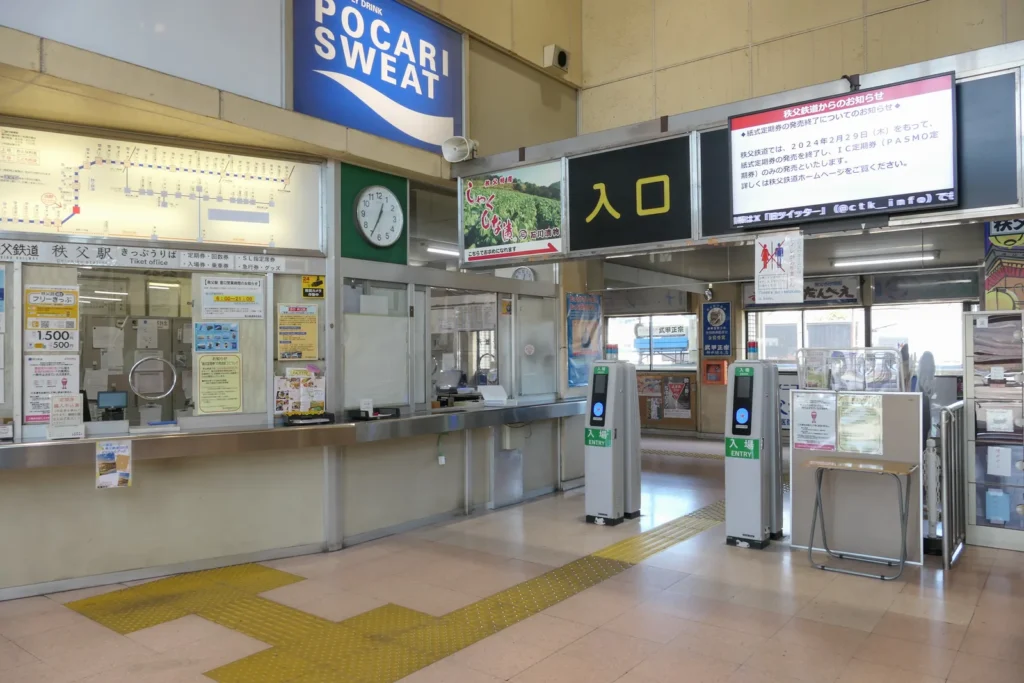
Three stations in the centre, and they are not the same
- Seibu-Chichibu — Seibu terminus. Tourist information centre and the onsen complex in front of it.
- Ohanabatake — Chichibu Railway, a few minutes’ walk from Seibu-Chichibu, and the interchange between the two companies. Separate gates, separate tickets.
- Chichibu — Chichibu Railway, one stop on, beside the local products centre and closest to the shrine, Banba-dori and Jorin-ji.
About the city’s pilgrimage course
- Chichibu publishes a pilgrimage course covering both anohana and The Anthem of the Heart, with each stop marked for one film or the other. It is the best list of which places to visit.
- Read the markers. A stop on that course is not automatically an anohana stop.
- Its train times and service names date from when it was written. Plan the journeys from the current Seibu, Chichibu Railway and Seibu Bus timetables, which is what this guide does.
Best Way to Get Around
Verdict: walk the four central stops, hire a bicycle if you want the bridge without the hill back, and only use buses for Shimo-Yoshida.
On foot
The centre is compact. Seibu-Chichibu to Ohanabatake is a few minutes; Chichibu Station, the shrine, Banba-dori and Jorin-ji are all within about fifteen minutes of each other. The old Chichibu Bridge is the one that stretches the day — roughly half an hour on foot north of the centre, and uphill coming back.
Bicycle
Chichibu publishes its own rental-cycle map with the anohana spots marked on it, which tells you what the city thinks the right way round is. A bicycle turns the bridge from a commitment into a detour and makes the whole central circuit comfortable in half a day.
Bus
Seibu bus routes run out to Shimo-Yoshida, the outlying temples, the dams and Mitsumine. They are the only public way to most of them and they are not frequent — look up the return journey before you set out, and expect thinner timetables at weekends and in winter.
Car
Useful only for the outlying half of the city. The central four stops are better on foot, and parking near the shrine on a festival weekend is its own small ordeal.
What to Eat
Chichibu eats well for a town this size, and almost all of it is within the same walk as the locations.
Soba
The city counts around sixty soba restaurants in the basin and calls the Arakawa district out west its soba village, where the fields go white with flower twice a year. There is a new-soba festival in autumn. One sit-down meal, make it this.
Miso potato
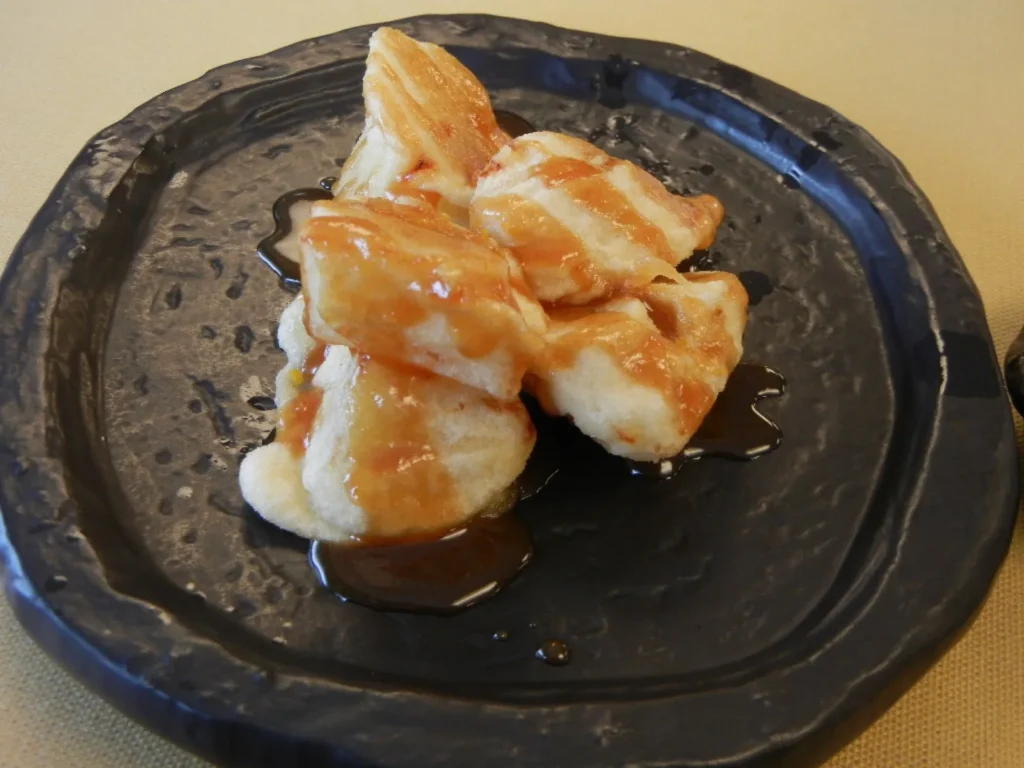
Steamed potato, battered, fried and finished with sweet-savoury miso. A few hundred yen on a skewer from festival stalls, roadside stations and small shops. The thing to eat while walking between stops.
Waraji katsu and horumon
Waraji katsu is a pork cutlet shaped like a straw sandal, usually two of them over rice, and it is the local answer to a large lunch. Pork horumon — grilled offal — is the local answer to the evening.
And the local drink
Chichibu has old sake breweries in the middle of town and its name on an internationally collected single malt. It is a good town to end a day in. If you want that side of Chichibu properly, our Botan Kamiina guide is built around it.
Beyond the Anime: More to See
None of these is on the city’s anohana list. They are here because Chichibu is a real destination with or without the series.
The Chichibu pilgrimage in its Horse year
Thirty-four Kannon temples, about 100 km, founded by tradition in a Year of the Horse. 2026 is a Horse year, and the once-in-twelve-years Umadoshi Sokaicho runs from 18 March to 30 November 2026. Jorin-ji is number 17 and Daiji-ji is number 10, so if you are here before the end of November you are already on the circuit. Stamp reception is 8:00 to 17:00 from March to November, with a break from 12:00 to 12:30.
The Chichibu Night Festival
Early December, at Chichibu Shrine: enormous floats hauled up a slope by hand, and fireworks in winter air. It is one of the great festivals of the region and the single busiest date in the town’s year. Book months ahead or do not come that week.
Hitsujiyama Park and the shibazakura
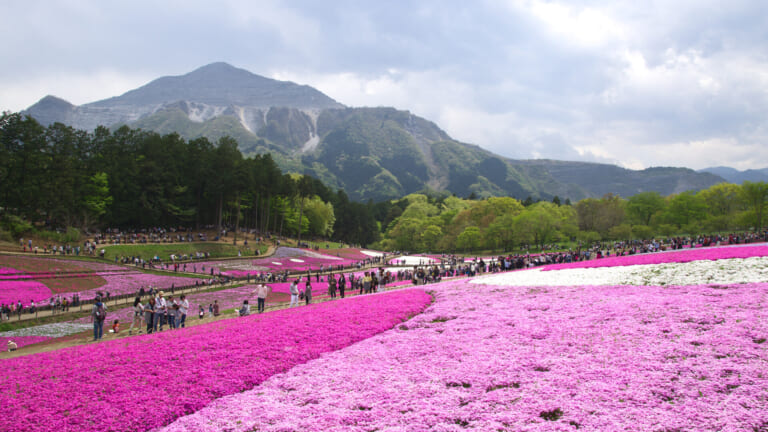
The hillside park above the town is planted with hundreds of thousands of moss phlox in bands of pink and white, flowering mid-April to early May with Mount Buko behind. In 2026 entry was charged from 10 to 30 April at 500 yen for adults, free for junior high age and under, 8:00 to 17:00, and the slopes were past peak by 2 May. Out of season it is a free hillside with a very good view and no flowers.
The river and the mountains
- Nagatoro — fifteen minutes downriver on the Chichibu Railway: flat rock shelves along the Arakawa, boats on the rapids in season, and a ropeway up Mount Hodo (1,200 yen return for adults).
- Mount Buko — the quarried limestone mountain behind every photograph of Chichibu. A full day to climb.
- Mitsumine Shrine — high in the mountains at the head of the valley, reached by bus from Seibu-Chichibu. Half a day on its own.
Souvenirs and Where to Buy Them
The local products centre beside Chichibu Station and Michi-no-Eki Chichibu between them cover nearly everything, and both are official information points for the anime maps.
- Chichibu sake, from breweries inside the town.
- Dried soba from the Arakawa growing district.
- Miso, including the sauce for miso potato.
- Temple stamp books — if you are doing the pilgrimage in its Horse year, buy the book at your first temple.
- Chichibu Night Festival goods, which are available year round even though the festival is not.
For the series itself, availability depends entirely on whether an anniversary campaign is running. The 2026 fifteenth-anniversary stamp rally and its can badges are gone — it closed early when stock ran out. Check the city’s anime page before you count on finding anything.
Where to Stay
Chichibu is a comfortable day trip from Tokyo, and itinerary A below is written to work as one. Stay over if you want the second day, the night festival, or an evening in the town.
- Around Seibu-Chichibu Station — hotels and ryokan on foot from the station, the bars and the onsen complex.
- Nagatoro — riverside inns, quieter, good if the river is your second day.
- Tokyo — and come out for the day, which is what most visitors do.
Book early for the night festival and for late April (the shibazakura). The Chichibu Night Festival is on fixed dates — 2 December, the eve, and 3 December, the main day, every year — so in 2026 it falls on a Wednesday and a Thursday, not a weekend. We have not checked availability for any date; this is a reason to book in good time rather than a claim that the town fills up. Chichibu City had not published the 2026 traffic restrictions, temporary parking or float times when this guide was checked on 26 October 2026.
Suggested Itinerary
This is a story about six friends and the places they shared, so the trip is a walk between four of them in the middle of Chichibu. Those four are one afternoon on foot; everything else on the city’s course needs a bus, a timetable and a decision.
| Which trip | The central four | Add the old bridge properly | Shimo-Yoshida as well |
|---|---|---|---|
| What | Jorin-ji, Banba-dori and the shrine, Hot Spot Chichibu-kan, Keyaki Park | The same, plus time at the bridge for the light | Ryusei Kaikan, the rocket festival museum |
| Transport | On foot between the three central stations | Half an hour on foot from Chichibu Station, or a short bus or bicycle ride | About half an hour by bus on a thin timetable |
| Time | An afternoon | A full day | A second day |
| If you have one day | Do this | Do this too if the weather is good | Skip it |
A is the trip. It is one day, on foot, and it covers everything the city names in the centre of town.
A — One day in Chichibu
- Morning. Laview to Seibu-Chichibu. Collect the anime map at the tourist information centre in front of the station.
- Late morning. Walk to Jorin-ji. Give it longer than you think; it is small, and the point is to stand in it rather than photograph it and leave.
- Midday. Chichibu Shrine and Banba-dori, with Hot Spot Chichibu-kan on the way. Soba or waraji katsu for lunch somewhere along here.
- Afternoon. Out to the old Chichibu Bridge — half an hour on foot, or ten minutes on a hired bicycle. This is the one that wants good light, so do not leave it until dusk in winter.
- Late afternoon. Back via Keyaki Park and the local products centre by Chichibu Station.
- Evening. Horumon and a drink, or the onsen at Seibu-Chichibu, or the train home in daylight. All three are reasonable.
B — Two days, adding Shimo-Yoshida
Day one is A. Day two takes the bus out to Ryusei Kaikan and Muku Shrine at Shimo-Yoshida — the rocket festival museum, closed Tuesdays. Check the return bus before you leave town. This is a half-day with a lot of waiting in it, and it is optional.
If you would rather add Daiji-ji, treat it as a stop for The Anthem of the Heart rather than for anohana, and as a separate leg: Shimo-Yoshida is out to the north-west of the town and Daiji-ji is over in Yokoze to the south-east, so you would be coming back through the centre and setting out again on a different service. We have not checked whether the two timetables connect well enough to do both in one day, so plan it as its own outing unless you have looked the services up for your date.
Doing this with the other Chichibu series
anohana and Botan Kamiina are both set here and they want different days. anohana is the town centre on foot: a temple, a street, a shrine, a bridge. Botan Kamiina is the hillside park, the mountain and Nagatoro, and an evening with a drink in it.
What they certainly share are the practical bases: Seibu-Chichibu Station, the tourist information centre in front of it, the Ohanabatake interchange and the old streets you will walk through either way. Those are places both trips use, which is not the same as places both works are confirmed to visit. We have compared the two guides against the sources we could read — the anohana locations from the city’s marked course, the Botan Kamiina ones from the official synopses and the city’s own notices — and found no location confirmed for both. The Botan Kamiina paper map has not been read, so treat that as “none found” rather than “none exists”.
A two-day Chichibu plan covering both
- Day one, in town: the anohana walk — Jorin-ji, the shrine, Banba-dori, the old bridge — and an evening in the horumon shops and breweries, which is where the two series meet.
- Day two, out of town: Hitsujiyama Park for the Botan Kamiina opening scene, then the Chichibu Railway to Nagatoro for the river and the ropeway.
- Same two railway companies, same interchange at Ohanabatake, one hotel. The full version of day two is in our Botan Kamiina guide.
- Note that Hitsujiyama Park and Nagatoro are different places from the central walk — the hillside park is not the shrine district, and Nagatoro is a different town.
Travel Tips and Etiquette
The one that matters most here
Jorin-ji is a working temple with houses around it, the bridge is a public road, and Banba-dori is somebody’s street. Fifteen years of visitors have been mostly good about this and the town has stayed welcoming as a result. Keep it that way: speak quietly, do not block the path, do not photograph people at prayer or residents at home, take your rubbish with you, and do not go to the temple early in the morning or after dark.
Places not to go looking for
The characters’ houses and the secret base are not on the city’s list and are not identified here. Whatever you have seen pointed at online, those are private buildings and private land. Do not go, do not photograph, and do not post directions.
Practical
- Two railway companies. Seibu and the Chichibu Railway are separate, with separate tickets. Ohanabatake is the interchange and it is a short walk, not a connecting platform.
- Cash. Temples, small shops and some buses want it.
- Light. The bridge is a photograph; it wants daylight, and winter afternoons here are short.
- Crowds. Early December for the night festival and late April for the shibazakura are the two busiest dates.
- Bicycles make the bridge easy. The city publishes its own cycle map with the spots marked.
Plan Your Trip
The first one below shares a town with it; the others are suggested as route pairings rather than shared ground:
- Botan Kamiina in Chichibu and Nagatoro — the same town, fifteen years later and in a completely different mood. The two trips share their practical bases — the station, the information centre, the old streets — and we found no confirmed location in both works.
- Food for the Soul in Hachioji and Mount Takao — the other side of Tokyo, and another town that has leaned into being an anime destination.
- Your Name in Hida, Gifu — the obvious pairing for anyone who travels for this kind of story.
- Slam Dunk in Kamakura and Enoshima, Bocchi the Rock! in Shimokitazawa and Girls und Panzer in Oarai — other day trips out of Tokyo.
How this guide was put together
This guide was researched and planned from published sources rather than written up from a visit. Checked on 12 and 13 October 2026: Chichibu City’s own anime location course for which places are marked and for which work; Jorin-ji for the Horse-year special opening running to 30 November 2026 and its stamp reception hours; Daiji-ji’s own access page for the Yokoze address and the bus and walking times; and the Chichibu tourism association’s page for the 2026 Yoshida Ryusei festival, its date, start time and the change of special-bus departure point.
The joint course covers more than one film. Where the city marks a place for The Anthem of the Heart rather than for this series — Daiji-ji is the clearest case — this guide says so rather than quietly folding it in. Botan Kamiina is set in the same travel region and shares the town, but it does not share these locations; the two guides are kept separate for that reason.
Written and edited by Nick, who runs Anime Routes Japan from Japan. More about Nick, and about how these guides are made, is on the About page.
The practical details here — opening hours, fares, access and the operators’ own requests — were checked against official sources on 12 October 2026: the work’s own site and all eleven episode synopses, and Chichibu City’s tourism service for every real-world location. Train times come from the current operators rather than from the course page. Opening hours, events and timetables change — confirm the ones your day depends on, and give the temple more than five minutes.
This guide currently contains no affiliate links.